
Review · ITALY
Savona: Guided visit to the Priamàr Fortress
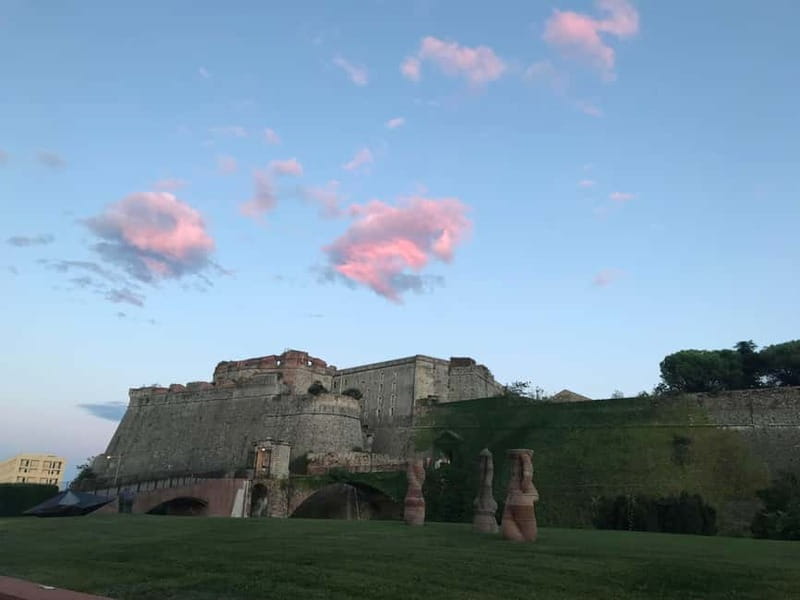
Ancient walls tell Savona’s story. The one-hour guided visit to Priamàr Fortress combines military history, archaeology, and open-air scenery in a compact tour that is easy to fit into a day in Liguria. I like the way the route connects the fortress to the city that once occupied this rocky promontory, rather than treating the fort as an isolated pile of walls.
I also like the personal style of the guides. Elena used quiz questions and humor, while Giorgio, Diego, and others have earned praise for their warmth and command of the subject. The main drawback is practical: the fortress is not suitable for wheelchair users or people with mobility impairments, and one booking was canceled after the scheduled meeting time, so I would confirm the arrangement before setting out.
Key things to know before visiting Priamàr
- The fortress replaced part of medieval Savona: Its construction destroyed a cathedral, bishop’s palace, Dominican convent, hospitals, and ten confraternity oratories.
- The guided route begins in the Civic Archaeological and City Museum: You start inside the fortress, at Piazza del Maschio.
- The fortification was built quickly: Genoa began work in 1542, and a garrison was in place by April 1543.
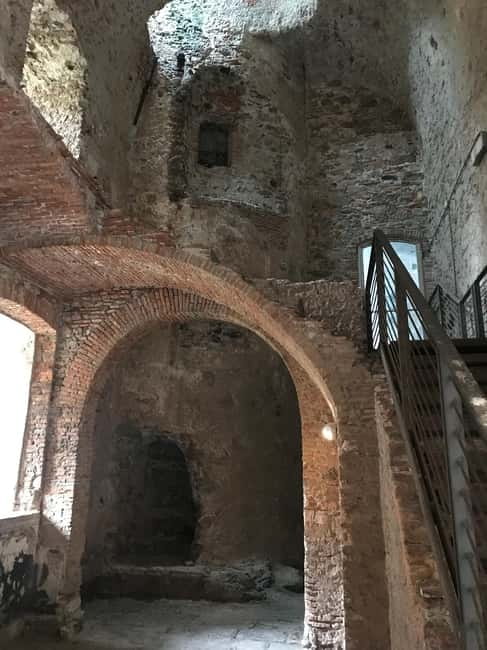
- Underground spaces may be part of the experience: One summer group switched to an underground route and found the passageways especially interesting and more comfortable in the heat.
- The tour costs $17 and lasts one hour: That makes it a sensible short stop, especially before or after exploring Savona independently.
- Guides speak several languages: English, German, French, Italian, and Spanish are offered, though some material may remain in its original language.
Why Priamàr matters to Savona
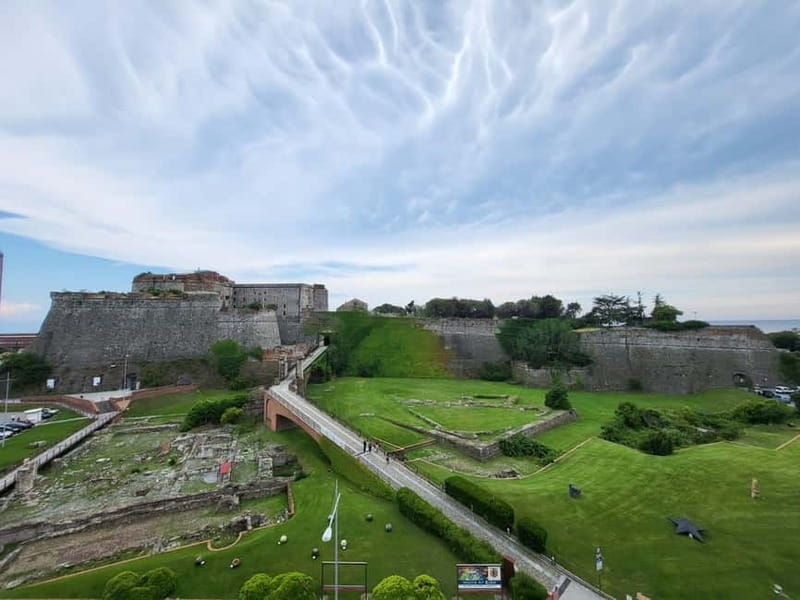
Priamàr is not simply a fortress placed above Savona. It occupies the site of the city’s first inhabited nucleus and later became the key military point in Genoa’s effort to control Savona.
The Republic of Genoa built the fortress between 1542 and 1544. The architect was Giovanni Maria Olgiati, a Lombard military designer. Genoa had two clear concerns: attacks from the sea and pressure from the Savoy state. Just as important, Genoa wanted to keep recently conquered Savona under firm control.
That political purpose gives the visit an edge. The walls protected territory, but they also watched the people below. The fortress was a weapon, a warning, and a permanent reminder of who held power.
Construction moved at remarkable speed. Only nine months after work started, the structure was already functioning well enough to receive its first garrison in April 1543. You can appreciate the urgency when you consider what had to be cleared from the hilltop first.
To make room for the ramparts, Genoa destroyed a major section of late medieval Savona. The lost buildings included the Cathedral of Santa Maria di Castello, the Bishop’s Palace, the Dominican Convent, three hospitals, and ten oratories belonging to religious confraternities. An entire district, also called Priamàr, disappeared beneath the military project.
That loss is central to the experience. You are not only looking at defensive walls. You are walking over the remains of a former neighborhood and the religious, civic, and charitable buildings that served it.
More Fortress and Citadel Tours in Italy
- Fortress: Prisons, Museum of Fortifications and Alps Museum
★ 4.5 · 125 reviews - San Leo: Fortress Entry Ticket and Cagliostro’s Prison
★ 4.2 · 38 reviews - Bard: Fortress Exhibitions and Museums Entrance
★ 4.3 · 29 reviews
Starting inside the Civic Archaeological Museum
The tour begins at the Civic Archaeological and City Museum of Savona, located within the Priamàr complex. The entrance is in Piazza del Maschio, under the portico.
Starting here gives the visit a useful order. Before you see the fortress as a military monument, you get an introduction to the older settlement and the archaeological evidence connected with Savona’s past. The museum helps explain what existed on the promontory before Genoa reshaped it.
The museum has been continually updated through the work of the International Institute of Ligurian Studies. Systematic archaeological excavation has taken place here since 1956, and the work continues to reveal more of the earlier settlement.
That long excavation record matters because Priamàr is not frozen in one period. Its story reaches from the first settlement through the medieval city and into the Genoese military era. The museum and archaeological areas help you see those layers together.
I would arrive with enough time to locate the museum before the start. The meeting point is not a separate visitor center at the foot of the hill. It is inside the fortress complex, at the museum entrance.
If you arrive by car, the museum can also be reached by elevators at the foot of the fortress. The elevators are on the first floor and are reached from a flat walkway near the parking area. This is useful for reducing the climb, although the experience is still not described as suitable for wheelchair users or people with mobility impairments.
Following the one-hour route through the fortress
The guided portion lasts one hour and returns to the same museum area. That short length is a strength if your time in Savona is limited. You get a focused introduction without giving up half a day.
The guide leads you through the most important parts of the monumental complex, explaining how each section relates to the city’s past. The route winds through the fortress rather than stopping at a single viewpoint or courtyard.
Expect a mixture of fortification walls, archaeological remains, and interior spaces. The setting brings together stone military architecture and the natural position of the rocky promontory. That combination is part of what makes Priamàr more interesting than a standard museum visit.
The exact route can vary. One group was able to switch to an underground version, which included underground rooms and passageways. The change was especially welcome during hot weather, but the underground spaces also added a strong sense of place. In a fortress, narrow passages and enclosed rooms can explain defensive planning more clearly than a diagram.
If your visit takes place during warm weather, ask whether an underground section is available. It may offer shade and cooler air, while also showing parts of the complex that are easy to miss from the main walls.
The guide’s role is important here. The fortifications can look impressive on their own, but the story gives them meaning. Without an explanation, it is easy to notice only the scale of the walls. With a guide, you can connect the structure to Genoa’s fear of attack, its conflict with Savoy, and its determination to control Savona.
The archaeological story beneath the ramparts
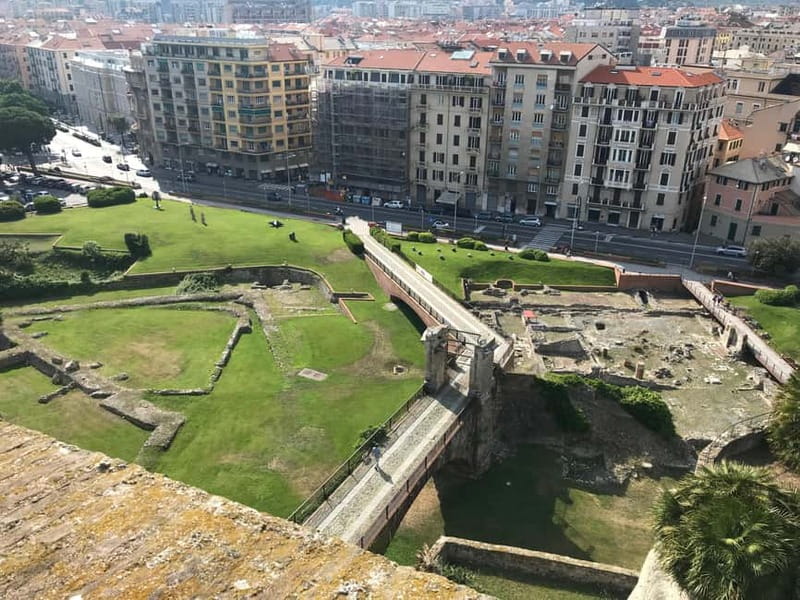
The archaeological work at Priamàr adds a human scale to the military monument. The fortress was designed to dominate the promontory, but the excavations reveal the people and institutions that occupied it before the fortification.
The destroyed cathedral and convent are not minor footnotes. They show the price Savona paid for Genoese control. The hospitals and confraternity oratories also remind you that the old district was a working part of the city, not simply a collection of grand buildings.
The archaeological areas inside and outside the fortress are gradually being enhanced. Some sections may feel like active historical research rather than a finished modern attraction. I consider that a plus if you enjoy seeing how the past is uncovered, though visitors who want a polished, fully restored monument may find parts of the site less immediately clear.
This is where a live guide earns the ticket price. The guide can explain what you are seeing and help you understand the relationship between exposed remains and later military construction.
The tour also helps place Savona within Liguria’s wider power struggles. Genoa’s fortress was not built for decoration. It was a practical response to regional threats and local resistance. The result is a monument that tells political history through its walls.
More Guided Castle Tours in Italy
- Milan: The Last Supper & Sforza Castle Guided Tour
★ 4.6 · 610 reviews - Milan: Last Supper and Sforza Castle Guided Tour
★ 4.6 · 498 reviews - Valpolicella: Amarone Chateau Guided Tour and Wine Tasting
★ 4.5 · 164 reviews - Milan: The Last Supper & Sforza Castle Guided Tour
★ 4.5 · 128 reviews
Guides who make the hour work
The strongest part of this experience is the human delivery. Elena has been praised for being kind, funny, and ready to answer questions. She also prepared quiz questions about the fortress, a simple touch that can keep the tour lively without turning it into a school lesson.
Giorgio has earned especially strong praise, as has Diego for sharing his enthusiasm for archaeology and the history of the fortress. Those details suggest that the tour is not locked into a dry script. The tone can be conversational and responsive.
A small group can make a real difference. One booking had only two people, which allowed the guide to give close attention and adjust the pace. Another guide slowed down to accommodate a visitor with a twisted ankle and spent more time explaining along the way.
That does not guarantee a private tour every time. Group size can change, and the supplied information does not set a maximum. Still, the one-hour format gives the guide enough time to respond to questions without making the visit feel endless.
The available languages are English, German, French, Italian, and Spanish. Some material may be presented in its original language, so if you need every explanation in English, confirm the language when booking.
Is $17 a fair price?
At $17 per person, I consider this a good-value introduction to Savona’s main historical monument. You receive admission for a guided visit, not just access to a fortress where you must work out the story alone.
The value is strongest if you care about context. The tour explains why the fortress was built, what stood here before it, and how archaeological work is changing the way the site is understood. A self-guided walk may show you the views and walls, but it is less likely to make the destruction of medieval Savona feel real.
The one-hour duration also keeps the cost reasonable. You can pair the visit with time in Savona’s center, a meal, or another museum without giving the entire day to one attraction.
The price is less attractive if you have already studied Priamàr, dislike guided visits, or cannot manage uneven historic spaces. In those cases, the tour may feel too short or too restrictive. For most first-time visitors who want a clear introduction, the cost is modest.
Free cancellation up to 24 hours before the visit and the option to reserve now and pay later add flexibility. Still, I would not rely on the appointment without checking the confirmation details. One booking was canceled one day later than scheduled, after the participants had arrived at the stated time and place. That appears to be an exception, but it is worth taking seriously.
Access, heat, and practical comfort
The fortress occupies a rocky promontory, and the experience includes historic areas that may be difficult for anyone with limited mobility. The activity specifically excludes wheelchair users and people with mobility impairments.
The elevators at the foot of the fortress can help you reach the museum from a flat walkway near the parking area. They do not change the stated suitability of the complete tour, so ask about the precise route before paying if stairs, slopes, or uneven surfaces are a concern.
Summer heat is another practical issue. The fortress combines open areas with enclosed and underground spaces. If the underground route is available, it may be the more comfortable choice on a hot day, as well as an interesting alternative.
The tour begins and ends at the museum. That makes the meeting point simple once you are inside the complex, but you should allow time to find Piazza del Maschio or the elevator entrance. Do not assume that arriving at the foot of the fortress means you have reached the tour’s actual starting point.
Who will enjoy this visit most?
I would recommend Priamàr to you if you like history that connects buildings to political decisions. The fortress explains Savona’s relationship with Genoa and shows how military power reshaped an older city.
It is also a good choice if archaeology interests you. The museum, excavation work, and exposed remains give the visit more depth than a simple walk along battlements.
Families may enjoy the quiz-style approach used by Elena, especially if children need something active to keep their attention. The one-hour length is manageable, and the fortress setting gives the visit a strong sense of discovery without requiring a full-day commitment.
The tour may be less suitable if you want a long, leisurely visit with plenty of independent time. It is structured and guided, and the route is built around explanation rather than free wandering.
It is also not the right pick for anyone with significant mobility limitations unless the provider confirms that a modified route is possible. The stated access warning should be treated as a real planning concern, not a minor footnote.
Should you book the Priamàr Fortress tour?
Book it if you want Savona’s main monument explained clearly and efficiently. The $17 price is fair, the one-hour format fits neatly into a larger day, and guides such as Elena, Giorgio, and Diego bring warmth and personality to the history.
I would especially choose it for the archaeological context and the chance to see underground rooms or passageways if that route is available. Confirm the language, meeting point, and current schedule before going, and allow extra care if the weather is hot or your mobility is limited.
Skip it if you prefer to explore completely alone or need a fully accessible attraction. For everyone else, Priamàr offers a compact, worthwhile look at how Genoa’s military ambition erased and then preserved part of Savona’s past.
FAQ
Where does the guided visit begin?
It begins at the Civic Archaeological and City Museum of Savona inside Priamàr Fortress. The entrance is in Piazza del Maschio, under the portico.
How long does the tour last?
The guided visit lasts one hour and returns to the Civic Archaeological and City Museum.
What is included in the $17 price?
The price includes the ticket for the guided visit to Priamàr Fortress.
Which languages are available?
The live guide may provide the tour in English, German, French, Italian, or Spanish. Some content is shown in its original language.
Can wheelchair users join the tour?
No. The activity is not suitable for wheelchair users or people with mobility impairments.
Is there an elevator to the fortress museum?
Yes. Elevators at the foot of the fortress reach the first floor, and they can be accessed from a flat walkway near the parking area.
Can I cancel the booking?
You can cancel up to 24 hours in advance for a full refund. You can also reserve now and pay later.
Just added around Italy
- HIKING TOUR: VARENNA, Castle of VEZIO Villa MONASTERO, FIUMELATTE★ 5.0 · 48 reviews
- Castles of Puglia Day Trip from Bari★ 4.5 · 7 reviews
- Enchanted Castle of Sciacca – Museum Tickets★ 3.5 · 63 reviews
- Taormina; Taormina Castle Tour★ 3.8 · 11 reviews
- St. Angel’s Castle: 2-Hour Private Tour★ 5.0 · 9 reviews
- Milan: Skip-the-line Sforza Castle and Museums Private Tour★ 4.7 · 7 reviews
- Siena: Tour and Wine Tasting in a Tuscan Private Castle★ 4.9 · 50 reviews
- Sforza Castle & Michelangelo’s Pietà Rondanini Guided Tour★ 4.7 · 3 reviews
Fortress & Citadel Tours, compared.
Carcassonne: Castle and Ramparts Entry Ticket
Read our review →
From Cairo Alexandria Catacombs, Citadel Day Trip with Lunch
Read our review →
Charleston historical walking tour with a Professor of History at The Citadel
Read our review →
Hue Customizable Tour with Imperial Citadel & Forbidden City
Read our review →
Desert Safari: Luxury Fortress Dinner, Camel Ride & Dune Bashing
Read our review →
Egyptian Museum, Citadel, and Old Cairo Guided Tour
Read our review →Browse the lists this tour appears in