

Review · USA
Charleston historical walking tour with a Professor of History at The Citadel
Charleston rewards curious walkers. This three-hour tour pairs the city’s streets with Eric Lager, a Citadel history professor, giving you far more context than a quick sightseeing stroll. I like the small cap of 12 people and the chance to ask detailed questions as you go. The main catch is the pace: you cover many sites in one morning or afternoon, so this suits you best if you enjoy a steady, information-filled walk.
I also like the route’s sweep from colonial Charleston through the Revolution, the early republic, and the Civil War. You finish at the Battery with a view toward Fort Sumter, rather than spending the tour inside one building. The $40 price is strong value for an expert-led group of this size, though admission to places such as the Heyward-Washington House and Old Exchange is not included.
Key points at a glance
- Eric Lager brings academic depth: He teaches history at The Citadel and holds a Ph.D., with a focus that includes American and European history in the 19th century.
- The group never exceeds 12: That makes it easier to hear, ask questions, and speak with the guide while walking.
- The route covers 13 important stops: You see churches, government buildings, historic homes, the French Quarter, and the Battery.
- Fort Sumter is viewed from shore: You do not take a boat to the fort or tour its grounds.
- Expect a serious history lesson: The walk covers politics, religion, architecture, slavery-era Charleston, the Revolution, and the Civil War.
- Plan for three hours on foot: A moderate level of fitness is advised, and the tour requires suitable weather.
Why this Charleston walk feels different

Charleston has no shortage of carriage rides, ghost walks, and short sightseeing tours. This one takes a more serious route. You are not simply shown a pretty house and given its construction date. Eric Lager connects buildings to the people, political fights, religious groups, and national events that shaped the city.
That difference matters in Charleston. A church may look like a fine old building, but its history can involve colonial power, changing denominations, slavery, war, and the growth of the new United States. A square can seem like a pleasant patch of grass until you understand the monuments and civic decisions around it.
Lager’s style, based on the experience described by past participants, is detailed but approachable. He is praised for answering questions, making jokes, and adjusting his talk to the group. One especially useful feature is the small size. With no more than 12 people, you are close enough to hear the explanation and interrupt with a sensible question without holding up a giant crowd.
I would choose this tour early in a Charleston visit. It gives you a framework for the rest of the city. Afterward, the churches, houses, and harbor views make more sense because you know what period and conflict you are looking at.
More Fortress and Citadel Tours in the USA:
- Simply Amazing Sitka Tour: Fortress of the Bear, Alaska Raptor, & Totems
★ 4.5 · 352 reviews - Charleston walking tour with a Citadel history professor
★ 5.0 · 105 reviews - Sitka: Totem Poles, Raptor Centre, & Fortress of Bears Tour
★ 3.5 · 15 reviews
Starting at Mills House and Dock Street Theater
The walk begins at 108 Meeting Street, outside the Mills House Charleston, Curio Collection by Hilton. The historic hotel provides an early link to the Civil War period, and the stop sets the tone for the tour: buildings are treated as evidence, not just backdrops for photographs.
You then reach Dock Street Theater, where the focus shifts to Charleston’s theatrical past and the characters tied to it. The attraction is not simply that this was an early theater. The guide uses the site to show how entertainment, public life, and social status worked in an older Charleston.
Each stop lasts roughly ten minutes, though the overall timing is approximate. That means you should expect a moving lesson rather than extended time inside each location. If you want to enter a building, examine exhibits, or take a long series of photographs, you may need to return later on your own.
The Pink House and Charleston’s early buildings
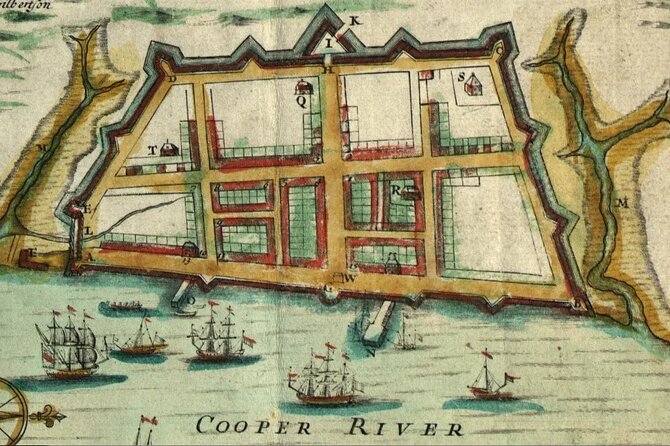
The Pink House Gallery is a short stop, about five minutes, at one of Charleston’s oldest buildings, dating to around 1712. It is a good reminder that the city’s story is not limited to grand public structures. Small, early buildings can reveal how compact colonial Charleston once was and how much of the old street pattern survives.
This is one place where the guide’s wider knowledge adds value. The building itself may take only a moment to see, but its age opens a window onto the city’s earliest period. You get a better sense of how old Charleston really is, rather than treating every historic-looking façade as part of one vague colonial era.
The stop is brief, so use it as a close look and listening point, not as a full museum visit. The tour keeps moving.
Washington Square, City Hall, and the old statehouse
Washington Square receives about 15 minutes, giving you a little more time to take in its monuments and civic setting. Squares are useful teaching spaces because they bring together public memory, government, and changing ideas about who gets honored. Here, the guide can place Charleston’s monuments within the larger story of the city.
At Charleston City Hall, you learn how the building changed from a meat market and bank into a seat of local government. That sequence is a compact lesson in urban growth. Public buildings often change jobs as a city develops, and this one lets you see that process in one location.
The Charleston County Courthouse adds another layer. The building once served as the old South Carolina statehouse, linking the city to the state’s political past. This is the sort of detail easy to miss while walking alone. You may notice the façade, but you would not necessarily know that the address once held a different level of power.
These stops should appeal to anyone interested in architecture and politics, not just military history. The tour does a good job of showing that Charleston’s past was made in offices, churches, markets, theaters, and squares, as well as on battlefields.
More Castle Walking Tours in the USA:
- Tahoe: Emerald Bay Cruise & Vikingsholm Castle Walking Tour
★ 4.7 · 4 reviews - Edinburgh Castle: Guided Walking Tour with Entry Ticket
★ 4.7 · 11,699 reviews - Prague: 3-Hour Walking Tour of Old Town & Prague Castle
★ 4.7 · 5,696 reviews - Edinburgh Castle: Guided Walking Tour with Entry Ticket
★ 5.0 · 5,540 reviews
St. Michael’s Church and the religious story
St. Michael’s Church is one of the major stops. Completed in 1761, it is the oldest church edifice in Charleston, and the guide explains why it matters.
The value here is historical context. Religious buildings shaped daily life, public authority, and community identity in colonial and early American Charleston. The stop also helps you read the city’s architecture with more care. Instead of seeing an old church as a beautiful object only, you begin to ask who built it, who worshiped there, and how its role changed over time.
The walk does not promise extended interior access at every site. Treat the church as part of the outdoor route unless your booking details state otherwise. If you want a full visit, check admission and opening times separately.
George Washington, the Old Exchange, and French Huguenot Charleston
The Heyward-Washington House marks the visit George Washington made to Charleston in 1791. This stop connects the city to the early national period and to the personalities who moved through the young republic.
Admission to the Heyward-Washington House is not included, so the tour’s treatment is primarily an exterior and historical explanation. That is fine for a broad walking tour, but you should budget separately if you want to go inside.
The Old Exchange and Provost Dungeon is another short stop. It was the last public building built by the British in North America, and the Constitution was ratified there in 1788. The name also points to the darker side of the site, with its former dungeon.
The French Huguenot Church shifts the focus to Charleston’s French Protestant community. You learn about the Huguenots and see the first church in Charleston built in the Gothic Revival style. This is an important reminder that Charleston was shaped by several European religious and cultural traditions, not one single colonial identity.
Admission to the Old Exchange is not included. The French Huguenot Church stop is listed as free, but the tour still gives you a limited amount of time there. Plan to return if you want a slower look.
The French Quarter and Hibernian Hall
The French Quarter receives about 15 minutes, enough to appreciate its streets and architecture while hearing how the district fits into Charleston’s story. It is one of the prettiest portions of the walk, but the guide keeps the focus on meaning rather than turning the stop into a simple photo break.
You then reach Hibernian Hall, where the discussion moves toward the political tensions that helped lead to disunion and the American Civil War. The building also provides a way to discuss Greek Revival architecture and America’s connection to that style.
This part of the tour is useful because it links design and politics. Architecture is not presented as decoration floating above events. The form of a building can reflect the ambitions, public ideals, and political world of the people who commissioned it.
Admission to Hibernian Hall is not included. As with the other paid sites, the stop should be understood as part of the walking tour rather than a ticketed interior visit.
The Battery and the view toward Fort Sumter
The final stop is at the Battery on Charleston Harbor, where you look toward Fort Sumter National Monument. This is where the first shots of the Civil War were fired, making it a powerful ending for a tour that has traced Charleston’s political and social development.
You do not travel out to Fort Sumter. You see it from shore, and the tour does not include admission or transportation to the fort. That distinction matters. If visiting the fort itself is a priority, you will need to arrange a separate boat trip.
The tour ends at 39 East Battery, near the Rainbow Row section of Charleston. That makes the finish convenient for further sightseeing, photographs, or a meal in the historic center. It also gives you a strong final view after three hours of walking and discussion.
What the three-hour format means for you
Three hours is long enough to cover a large slice of Charleston’s past, but it is not long enough to explore every interior or linger at every monument. I would expect a steady route with frequent stops, not a relaxed wander.
The subject matter is dense. Lager covers roughly 400 years, from the pre-Revolution period through the Civil War and beyond. That breadth is a major strength if you want a serious introduction, but it can feel like a lot if you prefer only a few headline facts.
You should wear comfortable shoes and bring water. Bottled water is not provided, and the tour requires a moderate level of fitness. Charleston weather can affect the experience, since the walk requires good weather and may be canceled if conditions are poor. If that happens, you can choose another date or receive a full refund.
The tour is offered in English and uses a mobile ticket. Service animals are allowed, and the meeting point is near public transportation. Private transportation is not included, but the route is a walking experience through central Charleston rather than a transfer between distant attractions.
Is $40 a fair price?
At $40 per person, the value depends on what you want from a guide. If you only want a quick orientation and a few dates, cheaper options may be enough. If you want an expert who can handle questions about politics, religion, architecture, and the Civil War, the price is reasonable.
The small group makes the fee more useful. You are not paying for a lecture delivered to a crowd of 30 or 40 people. You have a better chance of hearing every explanation and getting a direct answer from Eric Lager.
There are also no separate entrance fees built into the price for the paid attractions. That keeps the base cost clear, but remember to add admission if you later return to the Heyward-Washington House, Old Exchange, or Hibernian Hall. Fort Sumter requires a separate outing altogether.
Who should book this tour?
I would recommend it most strongly to:
- History fans who want more than dates and famous names.
- Architecture fans interested in churches, civic buildings, and Greek Revival design.
- First-time visitors who want a useful city orientation early in their stay.
- Small groups and solo visitors who value conversation with the guide.
- Couples and families with older children who can manage three hours of walking and sustained listening.
- People curious about the Civil War who want Charleston placed in a wider political story.
I would be more cautious if you dislike long explanations, need frequent sitting breaks, or want to spend most of the time inside attractions. This is an academic walking tour with humor and conversation, not a quick highlights loop.
Should you book the Charleston History Walk?
Book it if you want Charleston explained by a real historian rather than reduced to a string of dates. Eric Lager’s academic background, willingness to answer questions, and small-group format are the tour’s biggest strengths.
Choose it early in your visit, bring water, wear good shoes, and expect a full three hours of focused walking. Skip it only if you want a short, light sightseeing trip or if seeing Fort Sumter from the inside is your main goal. For history-minded visitors, the $40 fee buys a strong foundation for exploring the rest of Charleston on your own.
FAQ
How long is the Charleston historical walking tour?
The experience lasts approximately three hours.
How large is the tour group?
The group is limited to a maximum of 12 people.
Who leads the tour?
The tour is led by Eric Lager, Ph.D., a professor of history at The Citadel.
Where does the tour begin?
It begins at 108 Meeting Street, Charleston, South Carolina 29401.
Where does the tour end?
The tour ends at 39 East Battery near the Rainbow Row section of Charleston.
Does the tour go to Fort Sumter?
No. You view Fort Sumter from the Battery on Charleston Harbor. The tour does not travel out to the fort.
Are attraction admission tickets included?
All fees and taxes are included, but admission is not included for the Heyward-Washington House, Old Exchange and Provost Dungeon, Hibernian Hall, or Fort Sumter National Monument.
What happens if the weather is poor?
The experience requires good weather. If it is canceled because of poor weather, you can choose a different date or receive a full refund. You can cancel for a full refund up to 24 hours before the start time.
More History Tours in the USA
- Edinburgh: Edinburgh Castle Guided History Tour with Tickets
★ 4.8 · 9,933 reviews - Buda Castle District Dark History, Legends and Vampire Night Tour
★ 4.5 · 1,240 reviews - Luxembourg: Nature, History and Castles Full-Day Tour
★ 4.5 · 529 reviews - Dublin to Cork, Blarney Castle & Cóbh Heritage Centre by train
★ 4.5 · 510 reviews
Just added around the USA
- Half Day Tour to Faery Waterfalls, Castle Lake and Mount Shasta★ 4.5 · 6 reviews
- Small Group Day Trip to Salem and Hammond Castle from Boston★ 5.0 · 10 reviews
- Full-Day Private Guided Tour of Hammond Castle and Boston★ 5.0 · 2 reviews
- Private Day Trip to Salem and Hammond Castle from Boston★ 5.0 · 15 reviews
- Citadel Outlets Transfer from Anaheim with VIP Lounge, storage & LAX Drop-Off★ 4.0 · 7 reviews
- Tahoe: Emerald Bay Cruise & Vikingsholm Castle Walking Tour★ 4.7 · 4 reviews
- Springfield, Missouri, US: Ghost Tour inside Pythian Castle★ 4.3 · 3 reviews
- Sitka: Totem Poles, Raptor Centre, & Fortress of Bears Tour★ 3.5 · 15 reviews
Fortress & Citadel Tours, compared.

Carcassonne: Castle and Ramparts Entry Ticket
Read our review →

From Cairo Alexandria Catacombs, Citadel Day Trip with Lunch
Read our review →
Hue Customizable Tour with Imperial Citadel & Forbidden City
Read our review →
Desert Safari: Luxury Fortress Dinner, Camel Ride & Dune Bashing
Read our review →
Egyptian Museum, Citadel, and Old Cairo Guided Tour
Read our review →
Browse the lists this tour appears in