
Review · LISBON
Setúbal,Sesimbra & Palmela – Private tour, Nature & Culture
Portugal’s coast is closer than it looks. This full-day outing gives you three historic towns, mountain roads, beaches, forts, and sea views in one well-packed trip from Lisbon. I especially like the mix of nature and culture: you can inspect a medieval castle in Palmela, browse Setúbal’s famous market, then reach the clear waters of Portinho da Arrábida and the dramatic cliffs of Cabo Espichel.
I also like the personal format. Pickup and drop-off are included for a private booking, the vehicle has air conditioning and WiFi, and the guide handles the driving between scattered sights. If Hugo is your guide, you may get the warm, personal approach praised in the tour feedback, with food, conversation, and local places woven into the day. The main drawback is simple: eleven stops in seven to eight hours makes for a busy schedule, and several visits will be brief.
Key points to know before booking
- Palmela Castle starts the day with sweeping views across the Setúbal Peninsula and a strong medieval story.
- Setúbal’s Livramento Market is a real highlight, especially for its fish stalls and colorful tile panels.
- Arrábida Natural Park brings the best scenery, with forested mountains, clear water, and steep coastal roads.
- Sesimbra offers two very different fortifications, one above town and one beside the sea.
- Cabo Espichel is the wildest stop, with a cliff-edge sanctuary, old pilgrim buildings, and views over Lagosteiros Bay.
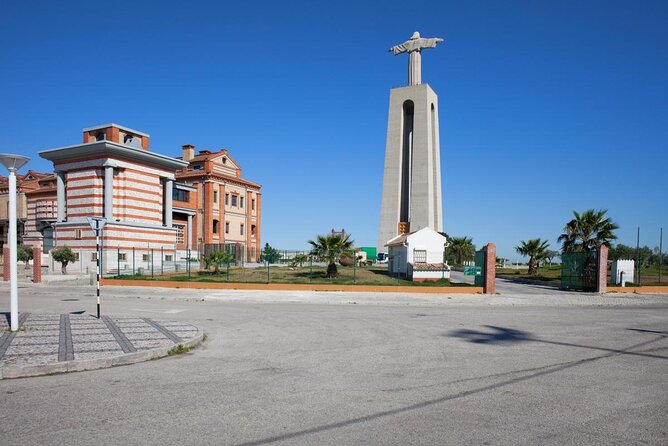
- Christ the King closes the route near Lisbon, with a broad view over the Tagus, Almada, and Lisbon.
Why this route works as a day from Lisbon
The Setúbal Peninsula is close to Lisbon but feels like a change of pace. The route links the inland heights of Palmela with the fishing town of Setúbal, the Arrábida hills, Sesimbra’s shore, Cabo Espichel, and the south bank of the Tagus.
That variety is the reason to choose a private day tour rather than a single sightseeing trip. You are not spending the whole day in one museum or one town. Instead, you get a quick introduction to several parts of the region, each with a different character.
The route is also practical if you do not have a car. Several stops are on hilltops or along roads where public transport would make the day awkward. A private vehicle saves you from planning connections between Palmela, Setúbal, Sesimbra, Cabo Espichel, and Almada.
At $90.31 per person, the value depends on your group size. The price includes private transportation, insurance, taxes, a driver, guided visits, and pickup or drop-off at your hotel, Airbnb, cruise terminal, or airport. It does not include lunch, snacks, tips, or personal purchases. For a small private group, that can be a fair price for a long day with a driver and guide. For one person, the cost feels less budget-friendly, though it still covers a large amount of ground.
More Private Castle Tours in Portugal
- Sintra Cascais Private Tour with Pena Palace and Mouros Castle
★ 4.5 · 280 reviews - Tomar and Almourol Castle Private Tour from Lisbon
★ 5.0 · 15 reviews - Private Tour – Tomar and Knights Templar Heritage
★ 5.0 · 4 reviews
Palmela Castle and the first look across the peninsula
Palmela Castle sits high in the Serra da Arrábida, in a position chosen for defense. The climb and difficult access once helped protect the territory south of the Tagus. Today, that height is your reward, since the castle gives you a useful view of the region before the tour heads toward the coast.
The castle is tied to Portugal’s Christian Reconquista and to the Order of Santiago. King Afonso Henriques granted Palmela, Almada, and Alcácer to the order for defense and settlement. In 1205, King Sancho I confirmed the donation and established the order’s chapter at Palmela.
Later changes tell another part of the story. King João I ordered restoration work in the fifteenth century, including work on the keep and a convent that became the order’s headquarters from 1443. The religious community remained there until the extinction of religious orders in 1834.
You have about 45 minutes here, and admission is included. That is enough for a look at the fortifications, the convent setting, and the views. It is not enough for a slow historical study, so I would listen carefully to the guide and use the stop to get oriented.
Setúbal’s market, tiles, and local flavor
Mercado do Livramento gives the day a change of rhythm. Opened in 1930 to replace an older market, it was renovated between 2010 and 2011. The market is known for its fish, but the building is also worth seeing for its tile work.
Inside, panels designed by Portuguese painter and engraver Pedro Pinto in 1929 show local economic activities. At the north entrance, two later panels by Rosa Rodrigues depict scenes from Setúbal and date from 1944.
You have 30 minutes here. That is a short visit for a market, particularly if you want to examine the tiles and browse the food stalls. Still, it gives you a direct look at the city’s daily food culture rather than another formal monument.
Setúbal is closely tied to the sea, so the fish market fits the town better than a generic shopping stop would. The market received international attention when USA Today named it one of the best fish markets in the world in 2014. I would use the time for a quick walk through the main aisles, then keep moving unless the schedule allows extra minutes.
Nearby, SetubalSouv offers handmade products from local artisans. The shop occupies a fish-shaped building made from cork and wood, which makes it an amusing, highly specific stop. Fifteen minutes is enough to look around, but this is the easiest stop to skip if you prefer more time at the forts or viewpoints.
The Church of Jesus and Setúbal’s old defenses

The Church of the former Monastery of Jesus is a compact but important architectural stop. Work began in 1490 and apparently finished around 1496 under Diogo Boitaca, who later worked on major Portuguese monuments including the Jerónimos Monastery, Belém Tower, and Batalha Monastery.
The church is associated with an early Portuguese attempt at a hall church, designed as one evenly lit interior space. Look for the round arches, ribbed vaults, and lowered arches. The design shows a period when builders were testing new ways to shape a large, unified interior.
The visit lasts about 15 minutes, so think of it as a guided introduction rather than a full church tour. It is a worthwhile stop for anyone interested in Portuguese architecture, but the short timing means you may have to choose between taking photographs and listening closely.
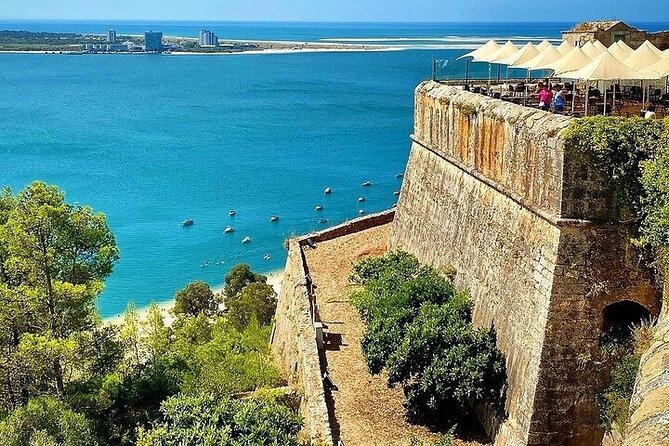
Next comes Forte de São Filipe, high above Setúbal. Philip II of Spain ordered the coastal fortifications in 1583, and Captain Fratino designed the fort in the shape of a six-pointed star with six bastions. Its purpose was to protect Setúbal and the mouth of the Sado River from attacks by pirates from northern Europe and Africa.
The fort’s tactical past matters, but its present appeal is the view. From the walls, you can look across the city and the bay. The 45-minute stop gives you more room than the church visit, though steep slopes and exposed viewpoints may make comfortable footwear useful.
More Private Castle Tours in Lisbon:
- Cairo Citadel, Old Cairo and Khan El Khalili: Private Tour
★ 4.6 · 741 reviews - From Amman: Jerash, Ajloun Castle or Umm Qais Private Tour
★ 4.7 · 360 reviews - Seville Private Walking Tour with Alcazar & Cathedral Tickets
★ 5.0 · 332 reviews - Skip-the-Line Wawel Castle Chambers Private Tour
★ 4.7 · 262 reviews
Serra da Arrábida and Portinho’s clear water
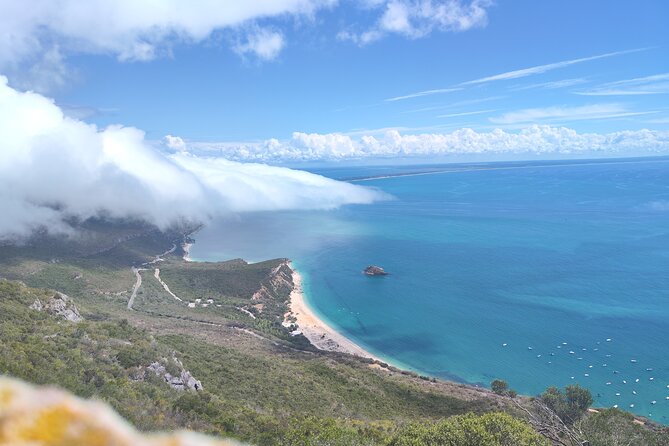
The Arrábida section is the scenic center of the day. The Natural Park covers about 10,800 hectares across Palmela, Sesimbra, and Setúbal. Its mountain ranges include Serra do Louro, Serra do Risco, Serra de São Luís, Serra dos Gaiteiros, Serra de São Francisco, and Serra da Arrábida.
The highest point reaches 501 meters, with views toward part of Portugal’s Vincentian coast. The roads pass through steep mountain terrain, then open toward the sea. The contrast between the green hills and clear blue water is the reason this part of the peninsula is so popular.
The general Arrábida stop lasts 45 minutes. Since the tour also visits Portinho da Arrábida, the two stops work together: one gives you the mountain setting and views, while the other takes you down to the shore.
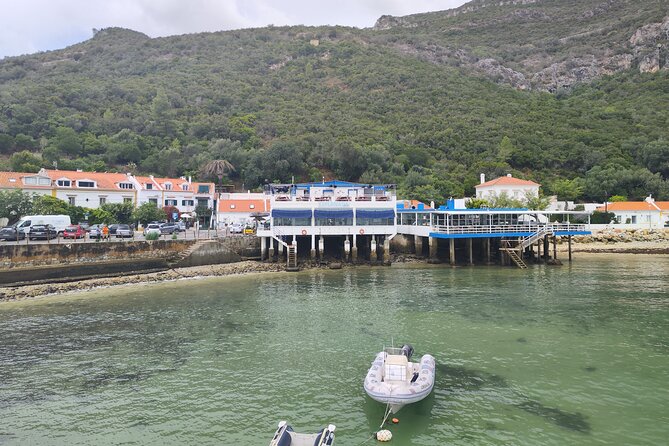
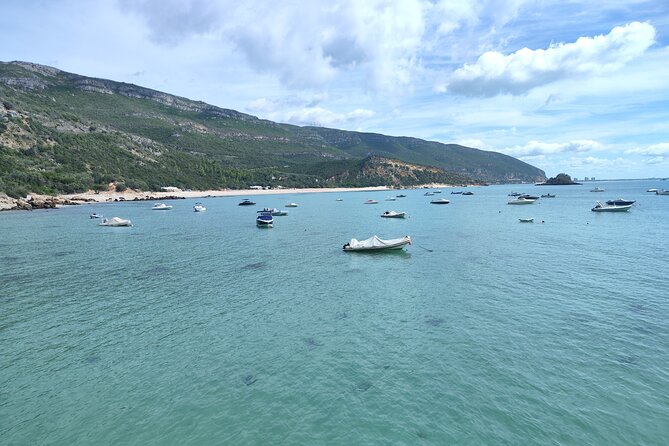
Portinho da Arrábida is a small seaside settlement at the foot of the mountain. Its beach is a narrow sandy and rocky stretch between Creiro and Alpertuche. The water is calm, clear, and cold, and the area is suited to swimming and underwater activities. Restaurants serve the beach area, although lunch is not included in the tour price.
You get about 30 minutes at Portinho. That is enough to see the cove and enjoy the setting, but it is not a beach day. Do not book this route expecting a long swim or a relaxed meal by the water. The beach was named one of Portugal’s seven natural wonders in 2010, so it is an appealing stop even when time is limited.
Sesimbra Castle above the fishing town
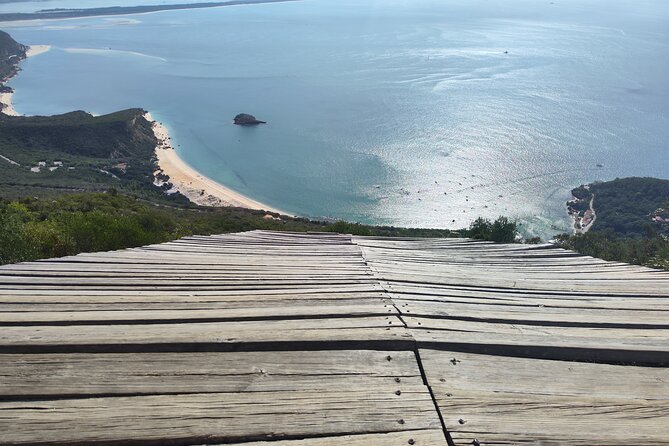
Sesimbra Castle is one of the strongest historic stops on the route. It is the last Portuguese castle beside the sea to retain its medieval design, and it was declared a National Monument in 1910.
The castle walls give you a broad view over Sesimbra and the water. Inside, you can find two permanent exhibitions, a heritage interpretation center, a church, and an old cemetery. A museum circuit guides you through the site, and a café terrace offers local products.
The 45-minute visit should let you walk along part of the walls and take in the town below. The key point is the position. Unlike Palmela, which looks across the peninsula from inland high ground, Sesimbra Castle looks directly over the coastal town and sea.
You should also expect some uphill walking at several fort and castle stops. The tour data says most people can participate, but the day includes elevated sites, steep terrain, and historic walls. If you have mobility concerns, ask the provider when arranging your pickup and meeting details.
Santiago Fortress and Sesimbra’s maritime story
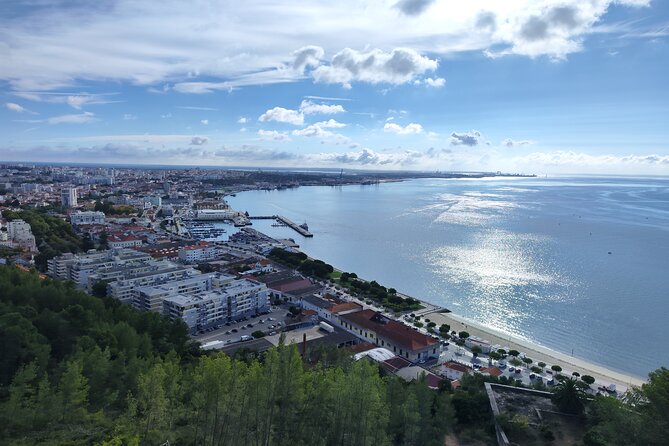
Fortaleza de Santiago sits in Sesimbra itself and has a more urban, seafront feel than the castle above town. Built when attacks from the sea were a serious concern, it protected the maritime border and worked as part of the town’s defense.
The fortress was restored and opened to the public in 2014. You can see spaces that once served as magazines, dormitories, and the governor’s residence. This is useful because it shows how the fort operated day to day, not just how its walls looked from outside.
In 2016, the building gained the Sesimbra Maritime Museum. The museum presents the story of the sea, fishing, and the local fishing community from early periods to the present. That focus adds local meaning to the fort. You are not simply seeing another military building. You are seeing the place where Sesimbra’s defensive needs met its long connection to the water.
The stop lasts 45 minutes. If you want to read every display in detail, you may find the time short. For a first visit, it gives you a solid sense of the building and its connection to Sesimbra.
Cabo Espichel’s cliff-edge sanctuary
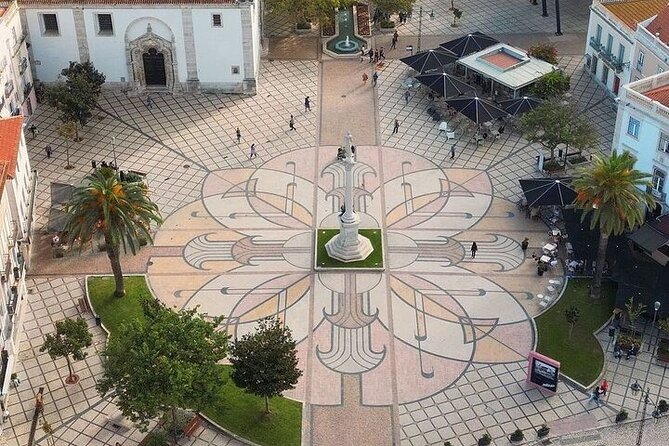
Cabo Espichel is the most dramatic setting on the route. At the southwestern end of the Setúbal Peninsula, the cape looks toward Lagosteiros Bay and the open sea. It lies within the Arrábida Natural Park, but the feeling here is more exposed and remote than at Portinho.
The Sanctuary of Nossa Senhora da Pedra Mua grew around the cult of Nossa Senhora do Cabo and the fourteenth-century Ermida da Memória. Local legend tells of an apparition of Our Lady. The present sanctuary took shape mainly in the eighteenth century under King Pedro II and King José.
The complex includes a church built between 1701 and 1707, two wings of guesthouses built between 1745 and 1760, a water house from 1770 supplied by an aqueduct, and an opera house from the late nineteenth century. Those buildings reveal how important the cape once was as a religious destination.
You have one hour here, the longest stop of the day. That extra time matters. It allows you to walk around the sanctuary, take in the cliffs, and hear the story without feeling quite as rushed as at the Setúbal church or souvenir shop.
Cabo Espichel can be windy and exposed, so bring a layer even if Lisbon feels warm. The views are the main reason to come, but the old religious complex gives the stop more substance than a simple lookout point.
Christ the King and the view back toward Lisbon
The final stop is the National Sanctuary of Christ the King in Almada. The monument was inspired by a promise made by Portuguese bishops in 1940. They vowed to build a monument to the Sacred Heart of Jesus if Portugal were spared from World War II.
Portugal remained neutral and did not take part directly in the war. A national fundraising campaign followed, and the monument was inaugurated in 1959. It rises 113 meters above Almada and Lisbon, offering a 360-degree view across both banks of the Tagus and the surrounding area.
The monument’s four pillars represent the four cardinal points. Between them is the Chapel of Our Lady of Peace, with a statue that replicates an image given to the Church of Saint Eugene in Rome during the Holy Year of 1950.
You have 45 minutes here. After a day of castles and coastal viewpoints, this provides a final broad view of the Lisbon region. It is also a useful closing stop because it shifts your attention from the peninsula back toward the capital.
The pace, vehicle, and guide service
The tour begins at 9:00 a.m. and lasts roughly seven to eight hours. A private booking includes pickup and drop-off at hotels, local accommodation, cruise terminals, and the airport. A shared version meets at the Hard Rock Café in Lisbon or Casa da Baía in Setúbal.
The vehicle is air-conditioned and has WiFi. Private transportation matters here because the sights are spread over a wide area, and the day includes mountain roads, beach access, hilltop castles, and a final stop across the Tagus.
The listed maximum is 16 people, but a private booking should give your own party a more personal arrangement. Use WhatsApp with the contact provided to agree on the pickup point and make communication easier.
The guide is a major part of the value. The strongest praise centers on Hugo, whose warm manner, local knowledge, conversation, and attention to food helped make the day feel personal. The service includes a guided tour of the monuments, so you are not left to work out the meaning of each fort and church by yourself.
The main practical issue is timing. The stated stops add up to about six hours and 45 minutes before driving time, and the complete tour is only seven to eight hours. That means the actual time at each location may vary, and traffic or a longer lunch could affect later stops. Tell the guide early if one place matters most to you.
Lunch, costs, and what to bring
Lunch is not included, though the company can recommend restaurants. This gives you some flexibility, but it also means you should budget separately for food and drinks. Since Setúbal and Sesimbra are both connected to the sea, local seafood may be a natural choice, but the tour data does not promise a specific restaurant or menu.
The $90.31 price includes the vehicle, driver, guide service, WiFi, taxes, and full insurance coverage. Admissions at the listed stops are free, so you are mainly paying for transport, planning, and the guide’s time. That is a sensible arrangement for a private day, particularly if you are splitting the cost with family or friends.
Bring comfortable shoes, water, sun protection, and a light layer for Cabo Espichel. You should also carry a little extra for lunch, snacks, souvenirs, and a tip if you feel the service deserves one.
Free cancellation is available until 24 hours before the start time. Changes made inside that period are not accepted, and the experience requires a minimum number of participants. If the provider cancels for that reason, you are offered another date or experience, or a full refund.
Who should book this Setúbal day tour?
I would choose this tour if you want a broad first look at the Setúbal Peninsula without renting a car. It suits couples, families, cruise passengers, and small groups who care about both scenery and historic buildings.
It is especially good for you if you enjoy castles, forts, churches, markets, coastal viewpoints, and short walks. The private pickup is also useful if you are staying outside central Lisbon or need transport from a cruise terminal or airport.
I would hesitate if your ideal day means sitting on one beach, spending hours in a museum, or lingering over lunch. Eleven stops create variety, but they also create a schedule. You should treat this as an overview of the region, not a slow holiday day.
Should you book it?
Book this experience if you want maximum variety in one day and value a guide who can connect military sites, local food, religious buildings, and natural scenery. Palmela, Arrábida, Cabo Espichel, and the two Sesimbra fortifications give the route real range.
Skip it if you prefer a slower pace or already plan to visit Setúbal and Sesimbra independently. For most first-time visitors without a car, though, the mix of private transport, included pickup, free monument access, and a personal guide makes the $90.31 price a reasonable way to see a difficult-to-organize corner of Portugal.
FAQ
How long does the tour last?
The experience lasts approximately seven to eight hours and begins at 9:00 a.m.
Is pickup included?
Pickup and drop-off are included for private bookings at hotels, local accommodation, cruise terminals, and the airport.
Where does the shared tour meet?
The shared tour meets at the Hard Rock Café in Lisbon or Casa da Baía in Setúbal.
Is lunch included?
No. Lunch, snacks, personal expenses, and tips are not included, though restaurant recommendations are available.
Are admission fees included?
All fees and taxes are included, and the listed stops specify free admission.
What language is offered?
The tour is offered in English.
How many people can join?
The activity has a maximum of 16 participants. Private bookings are arranged for your own party with pickup and drop-off included.
Is transportation provided?
Yes. The tour includes private transportation in an air-conditioned vehicle with WiFi on board.
Can I cancel for a full refund?
Yes, if you cancel at least 24 hours before the experience start time. Cancellations or changes made less than 24 hours before the start time are not refunded or accepted.
Just added around Lisbon
- Tomar: Knight’s Templar Castle and Convent of Christ Tour★ 4.9 · 84 reviews
- From Lisbon: Tomar, Christ Convent & Almourol Castle Tour★ 5.0 · 64 reviews
- Sintra: Moorish Castle, Pena Palace, Cabo da Roca, & Cascais★ 5.0 · 6 reviews
- Discover Alfama with the Exterior View of São Jorge Castle★ 4.4 · 21 reviews
- Lisbon: Sintra, Pena, Moorish Castle, Regaleira & Cascais★ 4.8 · 136 reviews
- Lisbon: Tower of Saint George’s Castle Church Ticket & Drink★ 3.7 · 37 reviews
- Lisbon Tour: Cristo Rei, Belem, São Jorge Castle, 360°View.★ 4.9 · 18 reviews
- Lisbon: Saint George’s Castle Entry Ticket and Guided Visit★ 4.6 · 127 reviews
Private Castle Tours, compared.

Cairo Citadel, Old Cairo and Khan El Khalili: Private Tour
Read our review →
Seville Private Walking Tour with Alcazar & Cathedral Tickets
Read our review →
Sintra Cascais Private Tour with Pena Palace and Mouros Castle
Read our review →
Skip-the-Line Wawel Castle Chambers Private Tour
Read our review →
Castles of Transylvania: Private Day Trip from Bucharest
Read our review →
Dracula’s Castle, Peles Castle and Brasov – Private Day Trip from Bucharest
Read our review →
Private Walking Tour Alcazar and Cathedral in Sevilla
Read our review →Browse the lists this tour appears in