
Review · KYOTO
Kyoto: Nijo-jo Castle and Ninomaru Palace Guided Tour
History comes alive behind quiet wooden doors. This one-hour tour makes Nijo Castle easier to understand, especially through its English-speaking guides, who explain the shogun’s rooms, political customs, artwork, and palace life. I like the access to areas normally closed to general visitors, and I like that the short route leaves you time to explore the gardens on your own.
The main drawback is the extra admission fee, which you must pay in cash at the castle. The palace can also feel warm in summer because there is no air conditioning inside, and photography is not allowed in the palace.
Key points to know before you go
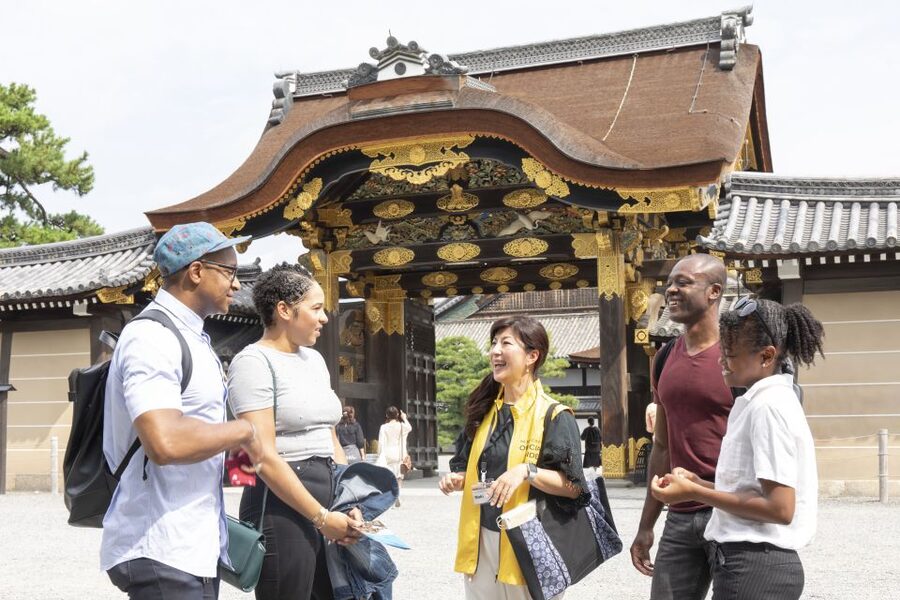
- The guide adds meaning to the palace: You learn why rooms were arranged as they were, what the paintings signified, and how the shogun used the building.
- Restricted areas may be included: The tour provides access to sections normally unavailable to the public, including parts connected with the shogun’s private quarters.
- The tour lasts 60 minutes: It covers the East Main Gate, Kara-mon Gate, Ninomaru Palace, and Ninomaru Garden.
- Admission costs extra: The $16 tour price does not include the castle entrance fee, which must be paid in cash on site.
- One child can join free: Each paid adult may bring one child aged 0 to 12 at no extra charge, but the child will not receive an earphone unless an adult ticket is purchased.
- English is the only tour language: Arrive early at the East Main Gate and check in at the reception area beside the General Reception desk.
Why Nijo Castle matters in Kyoto
Nijo Castle is not simply an old fortress with thick walls. It was built in 1603 as the Kyoto residence of Tokugawa Ieyasu, the first shogun of the Edo Period. The castle gave the shogun a base in the imperial capital, where political power, ceremony, and court tradition mattered as much as military strength.
After the Tokugawa Shogunate ended in 1867, the castle became an imperial palace. It was later given to Kyoto City and opened as a historic site. That change in use is part of what makes the visit so useful: the buildings connect the age of the shoguns with the later imperial period.
Nijo Castle became a UNESCO World Heritage site in 1994. Its surviving buildings are among the clearest examples of Japan’s feudal-era castle architecture, but the important point for you is this: much of the interest lies in details that are easy to miss without help.
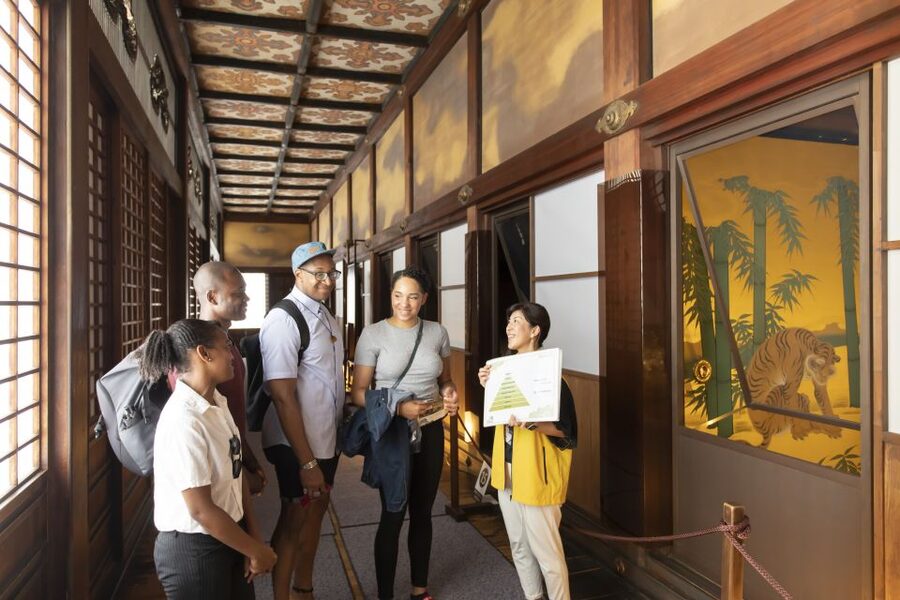
A painting of a tiger may look decorative at first. A room may seem empty. A gate may appear to be simply colorful and ornate. The guide gives these features a purpose, explaining rank, power, symbolism, ceremony, and daily life inside the palace.
More Guided Castle Tours in Japan
- Kyoto: Nijo Castle, Kiyomizu & Fushimi Inari Guided Tour
★ 4.7 · 700 reviews - Kyoto: Imperial Palace & Nijo Castle Guided Walking Tour
★ 4.7 · 453 reviews - Osaka Castle Guided Tour
★ 4.7 · 249 reviews
Meeting your guide at the East Main Gate
Your starting point is the Nijo Castle Tour Ticket Booth, with the precise meeting details provided after booking. Enter through the East Main Gate, then go to the reception area next to the General Reception desk, on the left after entering.
This step matters. You are not meeting outside the castle or at a nearby station. You need to enter the grounds first, pay the separate admission fee, and then report to the tour staff.
Arrive well before the start time. The tour cannot wait for late arrivals, and the route begins promptly. I would allow extra time for finding the entrance, handling the cash admission payment, and locating the reception desk.
The tour is conducted only in English. That makes it a practical choice for English-speaking visitors who want a clear explanation without trying to read every sign or depend on a translation app.
The East Main Gate and the first signs of power
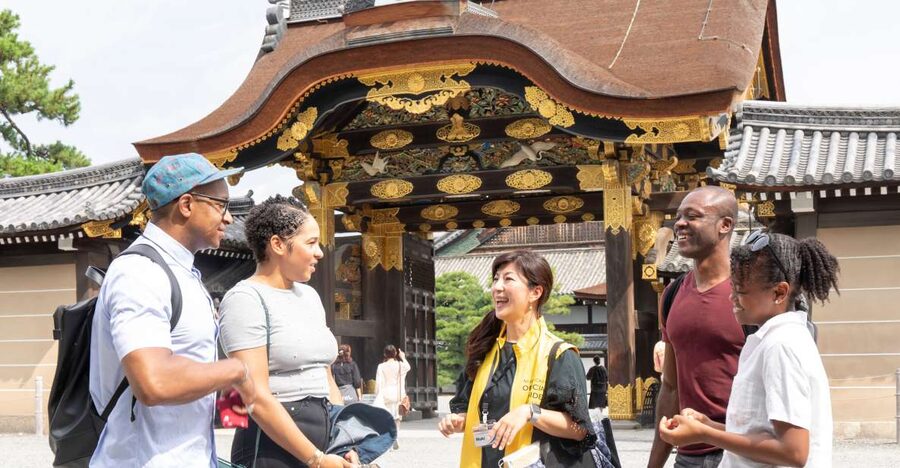
The route includes the East Main Gate, where the tour begins to frame the castle as a place of authority. Nijo Castle was designed to impress, control movement, and show rank. Even before you reach the palace, the gates and defensive layout help explain how the compound worked.
The castle is divided into three main areas: the Honmaru, or main circle of defence; the Ninomaru, or secondary circle of defence; and the gardens surrounding both sections. This arrangement is worth understanding because it gives the site a clear order rather than making it feel like a collection of unrelated buildings.
The guide helps you connect the physical layout with the political role of the castle. Nijo Castle was a Kyoto residence and working base for the shogun, not only a place to retreat during conflict. That distinction makes the palace visit more interesting than a quick look at military walls.
Kara-mon Gate, an ornate entrance to the palace
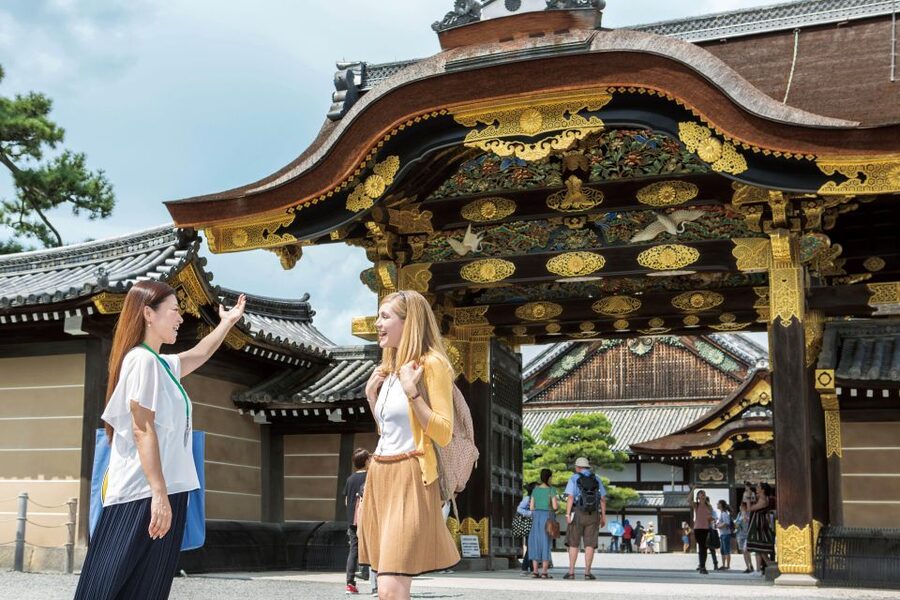
The Kara-mon Gate marks the entrance to the Ninomaru area. It is one of the most decorative points on the route, and the contrast with the defensive purpose of the castle is striking.
This is a good place to slow down and look upward. The gate’s carvings and decoration are not random decoration. Guides use details around the castle to explain status, symbolism, and the visual language of power.
One guide, Belinda’s account recalls, connected carvings with subjects familiar to modern visitors, including possible inspiration for Dragon Ball characters and Pokemon. Those links should not replace the historical meaning of the artwork, but they can make small details easier to notice and remember.
The Kara-mon Gate also prepares you for the Ninomaru Palace. Outside, the castle announces power through gates, walls, and formal approaches. Inside, power becomes more subtle, expressed through room order, painted panels, movement, and strict social rules.
More Palace Tours in Japan
- Imperial Palace East Garden and Edo Castle Walking Tour in Tokyo
★ 5.0 · 510 reviews - Kyoto: Nijo Castle and Kyoto Imperial Palace Guided Tour
★ 4.6 · 98 reviews - Tokyo: Edo Castle Ruins & Imperial Palace East Garden Tour
★ 4.4 · 13 reviews - Tokyo: Edo Castle and Imperial Palace Guided Walking Tour
★ 5.0 · 6 reviews
Ninomaru Palace, the heart of the tour
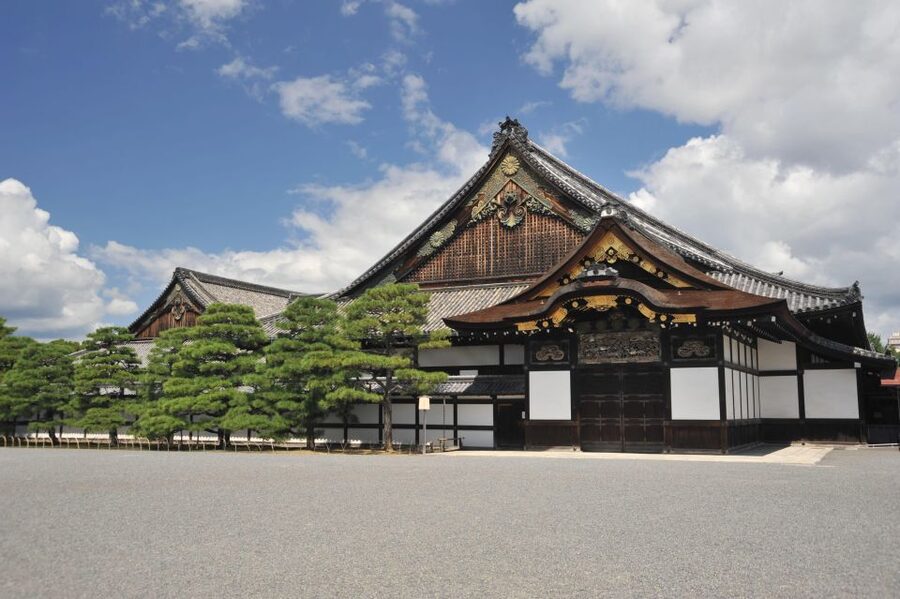
Ninomaru Palace is the main attraction. It served as the shogun’s residence and office during visits to Kyoto, and it remains intact.
You move through rooms used for different purposes, with the guide explaining where the shogun received people, where officials waited, and how access reflected rank. Several people who took the tour found that this explanation changed the palace from a series of empty rooms into a working political center.
The palace also helps you picture daily routines. One guide explained details connected with dinner preparation and the risks of poisoning, a useful reminder that palace life involved suspicion and careful control. Other explanations cover the shogun’s customs, court intrigue, and the balance between the shogunate and the emperor.
The painted panels are another major reason to take the tour. Guides point out the symbolism in murals and the meaning of particular animals, plants, and decorative scenes. You might notice tigers, dragons, or other motifs, but the guide explains why those images belonged in specific rooms and what they communicated to people entering them.
The palace is best appreciated slowly, but the building has practical limits. Photography is not allowed inside, so you need to pay attention rather than rely on taking pictures for later. There is also no air conditioning, and one visitor found the interior very warm during an August heat wave. Bring water for the wider castle grounds, but remember that water is not allowed inside the palace itself.
The guide-only areas add real value
The special access is one of the strongest reasons to book this experience. The tour includes entry to parts of the castle that are normally unavailable to the general public. One account described access to two additional spaces connected with the shogun’s private quarters.
The exact restricted areas may depend on operating conditions, but the added access gives the tour more than a standard walk through the public rooms. It also helps justify the cost of a guided visit when you could otherwise enter the castle and explore alone.
This is not a theatrical backstage experience. The value is quieter: you see more of the building and receive context at the same time. If you are already interested in Japanese architecture, political history, or samurai customs, those extra rooms may be the part you remember longest.
Ninomaru Garden and time to wander
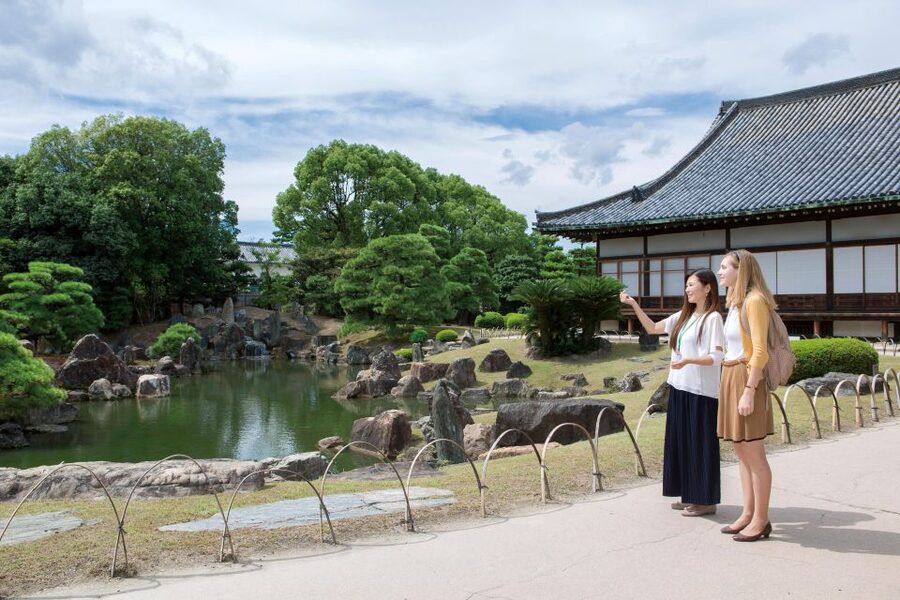
The tour includes Ninomaru Garden, which surrounds and complements the palace. After the concentrated indoor visit, the garden gives you space to slow your pace and take in the wider setting.
The one-hour route covers the main points, but it does not force you to leave as soon as the guide finishes. Several people liked the combination of a focused explanation followed by time to wander independently through the gardens.
That arrangement works well for a first visit. The guide handles the complicated background, while you can later return to details at your own speed. If you enjoy gardens, architecture, or quiet pauses between major sights, plan extra time beyond the advertised hour.
The grounds can also make the visit more comfortable after the palace. In hot weather, the outdoor sections still require effort, so carry water and take breaks. One guide was praised for watching the group’s comfort during very high temperatures, but the weather remains your responsibility.
The guides are the main strength
The experience depends heavily on the guide, and the praise for the guiding is unusually consistent. Guides named in tour accounts include Ai, Ayu, Kaoru, Miki, Kiku, Don, Michiko, Suzuki, and others. Their individual styles differ, but the strongest descriptions point to clear English, good pacing, humor, and a willingness to answer questions.
Kaoru was praised for combining historical detail with a funny and engaging manner. Ai was described as calm, expressive, and attentive to the group. Miki received repeated praise for her energy, clear communication, and ability to explain details even in hot weather.
The best guides do not simply recite dates. They explain the power structure of the period, the relationship between shogun and emperor, the meaning of palace artwork, and the customs surrounding samurai authority. That background helps you understand Kyoto beyond this one site.
Group size can vary. Some groups have been very small, with only four people, while other accounts describe busy conditions inside the palace. A smaller group makes questions and photos outside easier, but you should be prepared to stay close to the guide when the palace is crowded.
The tour also uses earphones for paid participants. This is useful inside a busy palace, where distance and other groups could make a normal speaking voice hard to hear. Children do not receive earphones unless an adult ticket is purchased for them.
Is $16 a good value?
The tour costs $16 per person, but the castle admission fee is separate and must be paid in cash on site. One price account put the admission at 1,300 yen, though you should confirm the current amount before your visit.
That makes the actual cost higher than the headline figure. Still, I think the tour offers good value if you care about understanding what you see. The guide-led access, room-by-room explanation, and historical context are difficult to reproduce by walking through alone.
The value is weaker if you prefer a quick, independent look at the buildings and gardens. You will need to follow the one-hour schedule, listen in English, and remain with the group through the main route.
For families, the price works better because each paid participant can bring one child aged 0 to 12 for free. The child must stay with an adult, and a second child requires an adult ticket. Families should also consider the heat, the no-photography rule, and the lack of air conditioning inside.
Timing, closures, and practical limits
The tour lasts 60 minutes, with several possible starting times depending on availability. Since the castle grounds and the palace can require more time than the guided route alone, I would not place this tour at the end of a tightly packed day.
The Ninomaru Palace is closed on Tuesdays in July, August, December, and January. It is also closed from December 26 through January 3. These closures affect the central part of the experience, so check the date carefully before booking.
Cancellation is free up to 24 hours before the start time. That is helpful if your Kyoto schedule changes, but it does not solve the main logistical risk: arriving late can mean losing the tour.
The tour is most comfortable in mild weather. Summer visitors should expect heat, especially inside the palace, while light rain does not necessarily stop the experience. One person found the tour worthwhile even in drizzle, but comfortable shoes and a drink for before or after the palace are sensible.
Who should book this Kyoto tour?
I would choose this tour if you want more than photographs of an impressive gate. It suits first-time visitors who want a clear introduction to the shogunate, families who benefit from the child policy, and anyone curious about Japanese art, architecture, and political ceremony.
It is also a good match if you are visiting Nijo Castle during a busy Kyoto day. The guide gives your visit structure and points out features you might otherwise pass without noticing.
I would skip it if you dislike fixed schedules, guided groups, or listening in English. You may also prefer independent exploration if the separate admission payment and one-hour commitment feel inconvenient.
Should you book the Nijo Castle guided tour?
Yes, if the extra admission fee fits your budget and you want the palace to make sense. The restricted access and consistently strong guiding add genuine value, especially inside Ninomaru Palace, where empty rooms and delicate artwork need explanation.
Book with enough time to enter through the East Main Gate, pay the cash admission fee, and find the reception desk. Arrive early, bring water for the grounds, and save time after the tour for Ninomaru Garden.
For most visitors, this is a smart short tour: focused, informative, and long enough to give Nijo Castle meaning without taking over your day.
FAQ
How long does the Nijo Castle guided tour last?
The guided tour lasts 60 minutes. It covers the East Main Gate, Kara-mon Gate, Ninomaru Palace, and Ninomaru Garden.
Is the castle admission fee included?
No. Admission to Nijo Castle is not included in the $16 tour price. You must pay the venue admission fee in cash on site.
Where does the tour meet?
Enter through the East Main Gate and go to the reception area next to the General Reception desk, on the left after entering. The meeting point is the Nijo Castle Tour Ticket Booth area.
What language is the tour conducted in?
The tour is conducted only in English and includes a live English-speaking guide.
Can children join the tour for free?
Each paid participant can bring one child aged 0 to 12 for free. The child must be accompanied by an adult. A second child must purchase an adult ticket.
Do children receive earphones?
Earphones are provided only to paid participants. If a child needs an earphone, an adult ticket must be purchased for that child.
Is the palace open every day?
No. Ninomaru Palace is closed every Tuesday in July, August, December, and January. It is also closed from December 26 through January 3.
More Japanese Castle Tours in Japan
- Osaka Castle: Museum and Tower Entry Ticket
★ 4.5 · 2,380 reviews - Osaka Castle Walking Tour and Castle Tower Admission
★ 5.0 · 561 reviews - From Osaka: Himeji Castle, Arima Onsen & Mt. Rokko Day Tour
★ 4.6 · 339 reviews - 5-Hour Osaka Bike Tour to the Neighborhood of Osaka Castle
★ 5.0 · 319 reviews
Just added around Japan
- Tokyo: Edo Castle and Imperial Palace Guided Walking Tour★ 5.0 · 6 reviews
- (Ticket Included) Explore Osaka Castle & Museum of History★ 4.8 · 21 reviews
- Peace Memorial Park, Hiroshima Castle, & Garden Private Tour★ 4.8 · 7 reviews
- Osaka: Explore Every Bit of Osaka Castle in 3 Hours★ 5.0 · 5 reviews
- Osaka/kyoto: Himeji Castle, Kobe. Luxury Day Trip with Guide★ 5.0 · 2 reviews
- Osaka: Osaka Castle 3 hours Historical Walking Tour★ 4.6 · 14 reviews
- Osaka: Osaka Castle – Tsuruhashi – Tennoji (Spanish Guide)★ 4.7 · 10 reviews
- Osaka: Early Morning Osaka Castle Guided Tour, Avoid Crowds★ 4.9 · 12 reviews
Japanese Castle Tours, compared.
Nijo Castle, Kiyomizu & Fushimi Inari Guided Tour
Read our review →
Osaka Castle Walking Tour and Castle Tower Admission
Read our review →
Imperial Palace & Nijo Castle Guided Walking Tour
Read our review →
Himeji Castle, Arima Onsen & Mt. Rokko Day Tour
Read our review →
5-Hour Osaka Bike Tour to the Neighborhood of Osaka Castle
Read our review →
Best of Himeji Castle: 3hr Tour with Licensed Guide
Read our review →Browse the lists this tour appears in