

Review · USA
Charleston walking tour with a Citadel history professor
Charleston makes the past feel close. This three-hour walk with Eric Lager, a Citadel history professor, links colonial streets, old alleys, graveyards, churches, and major public landmarks with the people and events that shaped the city. I especially like the small-group limit of 12 and the way the tour joins architecture, religion, politics, war, and everyday life instead of treating Charleston as a collection of pretty buildings. The one drawback is that three hours on foot can feel long in heat or rain, and the tour is not suitable for wheelchair users.
I also like that Eric teaches rather than simply recites dates. His style is detailed but friendly, with humor, room for questions, and attention to small design features you could easily pass without noticing. At $40 per person, this is a strong value if you want real historical context, though it may be more information than you want if your ideal city walk is mostly a quick sightseeing loop.
Key points to know before you book

- A true small-group walk: The group is limited to no more than 12 people, making it easier to hear Eric and ask questions.
- Led by a working historian: Eric Lager teaches at The Citadel and focuses on South Carolina and Charleston from the colonial era through the Civil War and beyond.
- Three hours in the historic district: Expect a steady walk with stops at alleys, graveyards, churches, theaters, parks, and civic landmarks.
- History beyond dates: Eric connects architecture, religion, culture, politics, military events, and the lives of famous and infamous Charlestonians.
- Several memorable sights: The route includes the Dock Street Theater, French Huguenot Church, Four Corners of Law, and Washington Park.
- Simple but important preparation: Wear comfortable shoes, carry water, and be ready for the tour to operate in ordinary rain unless conditions become unsafe.
Why this Charleston walk feels different

Charleston offers plenty of pleasant walking, but pleasant is not the same as meaningful. You can admire pastel facades, ironwork, church steeples, and narrow lanes on your own. The challenge is understanding what you are seeing and why the city developed in this particular way.
That is where Eric’s background matters. With nearly two decades of college teaching and public-history work, he brings a classroom level of preparation to an outdoor setting. You get stories, but you also get the surrounding facts: why a building was designed as it was, how religious communities influenced the city, and how Charleston’s local story fits into American history.
I like the balance. This is not advertised as a ghost walk or a quick photo stop tour. It covers the colonial period, the American Revolution, the antebellum era, the Civil War, and the city’s later development. That broad reach gives you a useful framework for the rest of your time in Charleston.
The tone is not stiff. Eric is described as funny, approachable, and willing to answer questions. He does not rely on cards or a scripted performance, which helps the walk feel like a conversation rather than a lecture with pavement underfoot.
More Fortress and Citadel Tours in the USA:
- Charleston historical walking tour with a Professor of History at The Citadel
★ 5.0 · 1,284 reviews - Simply Amazing Sitka Tour: Fortress of the Bear, Alaska Raptor, & Totems
★ 4.5 · 352 reviews - Sitka: Totem Poles, Raptor Centre, & Fortress of Bears Tour
★ 3.5 · 15 reviews
Starting at 108 Meeting Street
The meeting point is easy to locate once you know what to look for. You meet along the brick wall on the sidewalk in front of 108 Meeting Street, a building with four small white Ionic Greek columns. It now serves as a graphic design center for the City of Charleston and is not open to the public.
The building is directly across from Hibernian Hall and the pink Mills House Hotel. Since there are no restrooms at the meeting point, use the facilities at the Mills House before the walk begins. That is a small detail, but it matters when you are committing to three hours on foot.
I recommend arriving with water already in hand and shoes suited to Charleston’s historic streets. The tour does not include hotel pickup, food, drinks, or admission to house museums, so plan it as a walking experience rather than a packaged sightseeing excursion.
Old alleys and graveyards: seeing the city behind the facades

One of the best features of this walk is its attention to places you might skip. Old alleys and graveyards do not always announce themselves as major attractions, yet they reveal how Charleston worked and how its people understood the city.
An alley can show you the practical side of historic Charleston: movement between buildings, changing property lines, and the close relationship between public streets and private spaces. A graveyard adds another layer. Names, dates, inscriptions, and religious symbols can turn broad historical themes into individual lives.
Eric’s approach is especially useful here because he places these quieter sites alongside the better-known landmarks. You are not simply checking off a church or cemetery. You are learning how architecture, belief, family, commerce, and civic power met in the same few blocks.
The tradeoff is pace. Stops with a lot of detail may appeal to history fans but can feel slow if you prefer to keep moving. The small group helps because questions are easier to manage, and you are less likely to lose the guide in a crowd.
Dock Street Theater and the city’s cultural life

The Dock Street Theater gives the walk a chance to explore Charleston as a cultural center, not only a port, battlefield, or political stage. Its place in the route helps show how public entertainment fit into the city’s social life.
A stop like this is more valuable when you understand the people who could attend, the kinds of performances that mattered, and the social divisions surrounding public life. The building becomes more than a handsome facade. It becomes evidence of what Charleston valued and who had access to its institutions.
You should expect the tour to focus on historical context rather than entry inside every landmark. Admission to house museums is not included, and the experience is primarily outdoors. If you want to tour interiors, treat this walk as a foundation and arrange those visits separately.
More Castle Walking Tours in the USA:
- Tahoe: Emerald Bay Cruise & Vikingsholm Castle Walking Tour
★ 4.7 · 4 reviews - Edinburgh Castle: Guided Walking Tour with Entry Ticket
★ 4.7 · 11,699 reviews - Prague: 3-Hour Walking Tour of Old Town & Prague Castle
★ 4.7 · 5,696 reviews - Edinburgh Castle: Guided Walking Tour with Entry Ticket
★ 5.0 · 5,540 reviews
French Huguenot Church and Charleston’s many influences
The French Huguenot Church brings religious migration and cultural influence into the story. Charleston’s identity was shaped by people arriving with different languages, beliefs, traditions, and political experiences. A stop here helps you see that the city’s character did not come from one source.
This is where Eric’s broad approach pays off. He connects religious history with architecture and civic development, rather than isolating each subject. You may look at a church, but you are also considering how a congregation formed, how its members fit into Charleston society, and how religious institutions helped shape the city.
The church is also a reminder that Charleston’s historic district is not a museum set. It reflects arguments over faith, status, belonging, and power. That makes the walk more useful than a string of decorative observations.
Four Corners of Law and Washington Park

The Four Corners of Law is one of the clearest places to see Charleston’s civic structure. The name points to the institutions gathered around this area, where religious, political, and legal authority meet in a compact urban setting.
Eric uses landmarks such as this to explain how Charleston organized power. You learn to read the city as a plan shaped by law, religion, public administration, and social rank. That context changes the way you see nearby streets. Instead of asking only which building is oldest, you start asking what role each building played.
Washington Park adds a public open space to the route. Parks can look simple, but their location and design often reveal how a city represented civic pride and public memory. Here, the tour can connect monuments, public space, and Charleston’s changing view of its own past.
These stops are useful early in your visit because they give you a map in your head. After the walk, you can return to the historic district and recognize relationships between streets and institutions that might otherwise remain separate.
Architecture explained in plain language
A repeated strength of Eric’s tours is his attention to function. He does not merely point out that a home or building is old or attractive. He explains why certain features exist and what they tell you about the original occupants.
That might include the relationship between a building’s design and the local climate, the way rooms and entrances were arranged, or how architectural choices reflected status and custom. The supplied information does not set out a fixed list of architectural features, so you should not expect a technical building survey. You can expect architecture to be part of the historical story.
This is one reason I would book the walk even if you already know the basic Charleston landmarks. Several people who had visited before still found that the city looked different after learning how its structures were developed and used. Good guiding does not add clutter to a view. It gives the view a purpose.
Famous and infamous people brought back into the story

History sticks better when it has human characters. Eric includes stories about famous and infamous figures from Charleston’s past, using them to make larger events easier to grasp.
That does not mean the walk is built only around celebrity anecdotes. The stronger approach is to use individual lives as entry points into colonial society, revolutionary politics, slavery, war, religion, commerce, and civic change. The result should feel more like a sequence of connected stories than a list of names.
Eric’s humor helps keep the subject moving. Several descriptions of his guiding emphasize a jovial manner without losing the seriousness history requires. That balance matters in Charleston, where attractive streets can conceal difficult subjects. You want a guide who can hold your attention without turning painful history into entertainment.
A small group makes a real difference
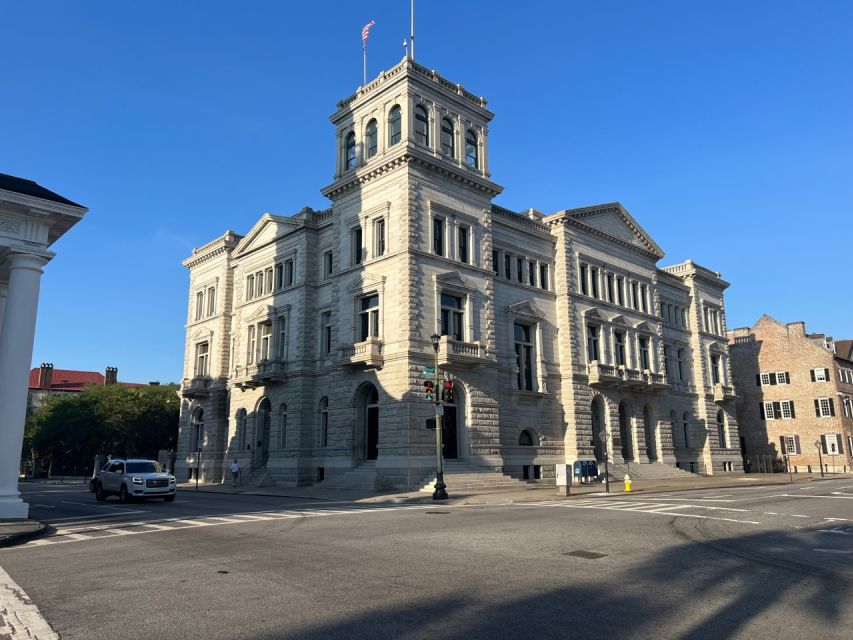
The group limit is one of the clearest advantages. The tour guarantees no more than 12 people, and the experience is often described as operating with 10 or fewer. That is small enough for questions to feel natural and for Eric to speak with people individually.
In a large group, a detailed explanation can turn into a struggle to hear. You may also hesitate to interrupt with a question. Here, the format supports conversation, and Eric can adjust his explanations to the interests of the people around him.
This is not a private tour, so the pace and subject matter will still be shared with other participants. Yet the size is notably more personal than groups of 20. If you are choosing between a cheaper, crowded walk and this one, I would consider the extra room to listen part of the price.
Is three hours and $40 a good value?
At $40 per person, the tour costs more than a basic orientation walk, but you are paying for time, preparation, and a specialist guide. Three hours gives Eric enough room to connect Charleston’s colonial origins with the Revolution, antebellum period, Civil War, and later city.
The value is strongest for you if:
- You enjoy history, architecture, or cultural sites.
- You want to ask questions instead of only listening.
- You are visiting Charleston for the first time and want a strong introduction.
- You have visited before but feel you have only seen the surface.
- You prefer a small group to a large commercial tour.
It may be less suitable if you want a short route, frequent indoor breaks, or a tour focused mainly on food, shopping, ghost stories, or house interiors. No food or drinks are included, and admission to house museums is separate.
The cancellation terms reduce the risk: you can cancel up to 24 hours ahead for a full refund, and you can reserve while paying later. Those options are useful when weather or a changing Charleston schedule makes planning uncertain.
Weather, walking comfort, and access
The tour runs rain or shine unless conditions become unsafe. Charleston’s weather can make three hours feel very different from one day to the next, so check the forecast and dress for exposure. Comfortable shoes and water are specifically important.
This is a walking tour through the historic district, not an accessible vehicle excursion. It is not suitable for wheelchair users, and assistance dogs are allowed even though ordinary pets are not.
I would schedule it when you have enough energy to listen. A morning or cooler part of the day may be more comfortable, depending on the starting time and season. Since the tour lasts three hours, avoid placing it immediately before another fixed activity unless you have a generous buffer.
Who should book this Charleston history walk?
I would choose this tour for anyone who wants Charleston to make sense, not merely look nice. It suits history buffs, architecture fans, first-time visitors, repeat visitors, and people who enjoy a guide with academic training but a relaxed manner.
Families with older children may also appreciate the stories and variety, though the amount of information will suit curious listeners best. If you want a quiet, self-guided stroll, you may prefer to explore alone and use the $40 for a museum admission.
Eric’s strongest quality is the blend of expertise and approachability. He has the academic background to answer detailed questions, but the experience is not presented as a formal class. You get a clear walking route, a small group, plenty of context, and a guide who clearly enjoys sharing Charleston’s past.
Should you book it?
Book this Charleston walking tour if you want one serious, well-paced introduction to the historic district. The small group, three-hour length, and Eric Lager’s background make it a good choice for travelers who want more than landmark names and dates.
I would book early if your schedule is tight, since the small capacity limits the number of places available. Bring water, wear good shoes, and expect outdoor walking in changing weather. If you want house interiors or a lighter sightseeing loop, choose a different activity or add those visits separately.
For $40, you are buying a fuller understanding of Charleston’s streets, buildings, institutions, and people. That is a fair price for a guide who can make the city’s details matter.
FAQ
How long is the Charleston walking tour?
The tour lasts three hours.
How much does the tour cost?
The price is $40 per person.
Who leads the tour?
Eric Lager leads the tour. He is a Citadel history professor with experience teaching at the college level and working in public history.
What subjects does Eric cover?
The tour covers Charleston from its founding in 1670 to the present, including the Colonial Era, American Revolution, Antebellum Era, and Civil War.
What sights are included?
The walk includes old alleys, graveyards, the Dock Street Theater, French Huguenot Church, the Four Corners of Law, and Washington Park.
How large is the group?
The group is guaranteed to have no more than 12 people.
Where does the tour meet?
It meets along the brick wall on the sidewalk in front of 108 Meeting Street. The building has four small white Ionic Greek columns and is across from Hibernian Hall and the pink Mills House Hotel.
What should I bring?
Bring comfortable shoes and water.
Can I cancel for a refund?
Yes. You can cancel up to 24 hours in advance for a full refund. You can also reserve now and pay later.
More History Tours in the USA
- Edinburgh: Edinburgh Castle Guided History Tour with Tickets
★ 4.8 · 9,933 reviews - Buda Castle District Dark History, Legends and Vampire Night Tour
★ 4.5 · 1,240 reviews - Luxembourg: Nature, History and Castles Full-Day Tour
★ 4.5 · 529 reviews - Dublin to Cork, Blarney Castle & Cóbh Heritage Centre by train
★ 4.5 · 510 reviews
Just added around the USA
- Half Day Tour to Faery Waterfalls, Castle Lake and Mount Shasta★ 4.5 · 6 reviews
- Small Group Day Trip to Salem and Hammond Castle from Boston★ 5.0 · 10 reviews
- Full-Day Private Guided Tour of Hammond Castle and Boston★ 5.0 · 2 reviews
- Private Day Trip to Salem and Hammond Castle from Boston★ 5.0 · 15 reviews
- Citadel Outlets Transfer from Anaheim with VIP Lounge, storage & LAX Drop-Off★ 4.0 · 7 reviews
- Tahoe: Emerald Bay Cruise & Vikingsholm Castle Walking Tour★ 4.7 · 4 reviews
- Springfield, Missouri, US: Ghost Tour inside Pythian Castle★ 4.3 · 3 reviews
- Sitka: Totem Poles, Raptor Centre, & Fortress of Bears Tour★ 3.5 · 15 reviews
Fortress & Citadel Tours, compared.

Carcassonne: Castle and Ramparts Entry Ticket
Read our review →

From Cairo Alexandria Catacombs, Citadel Day Trip with Lunch
Read our review →
Charleston historical walking tour with a Professor of History at The Citadel
Read our review →
Hue Customizable Tour with Imperial Citadel & Forbidden City
Read our review →
Desert Safari: Luxury Fortress Dinner, Camel Ride & Dune Bashing
Read our review →
Egyptian Museum, Citadel, and Old Cairo Guided Tour
Read our review →Browse the lists this tour appears in