
Review · GERMANY
Koblenz: Old Town Tour with the Ehrenbreitstein Fortress
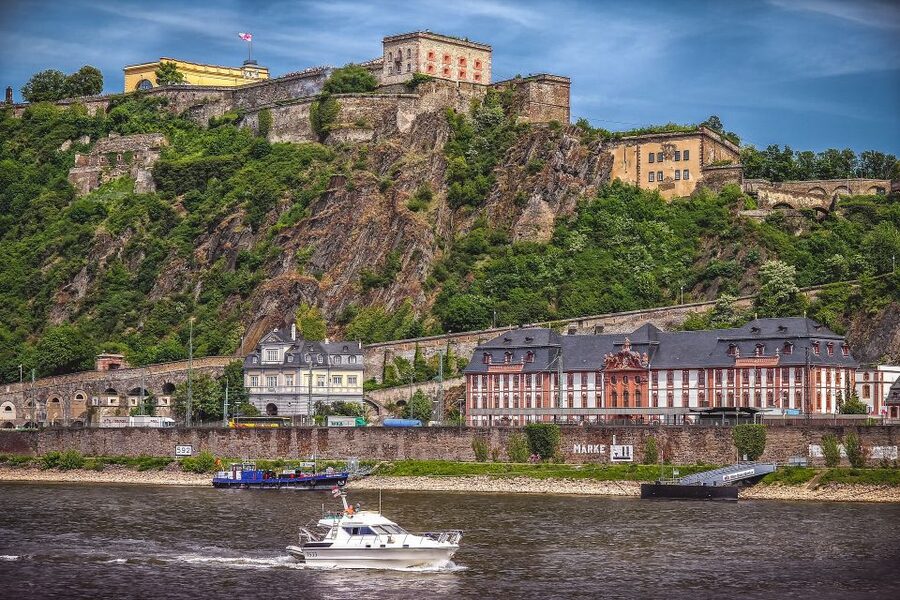
Koblenz reveals its best sights quickly. This private three-hour tour combines Ehrenbreitstein Fortress, the Old Town, and Deutsches Eck with a guide devoted only to your group. I especially like the sweeping Rhine Valley views from the fortress and the mix of major landmarks with smaller, quirky details in the historic center.
I also like the compact route. You get a useful first look at Koblenz without spending a full day on foot. The main consideration is the $430 group price, which is sensible for a larger party of up to 20 people but costly for one or two people, especially since the fortress admission is extra.
Key Points at a Glance
- Ehrenbreitstein Fortress: Begin 118 meters above the Rhine at one of Europe’s largest fortifications.
- Private guide: Your group has an English, German, or Italian-speaking guide without strangers joining in.
- Münzplatz and the Old Town: See the square linked to Koblenz’s Roman beginnings and the city’s medieval coin mint.
- Two important churches: Visit Liebfrauenkirche and the Basilica of St. Castor along the romantic street between them.
- Schängel Fountain and Deutsches Eck: Finish with two of Koblenz’s best-known civic symbols.
- Flexible arrangements: Pickup is available at a cruise docking location or a centrally located hotel, and the tour ends back at the cable car meeting point.
Starting Above the Rhine at Ehrenbreitstein Fortress

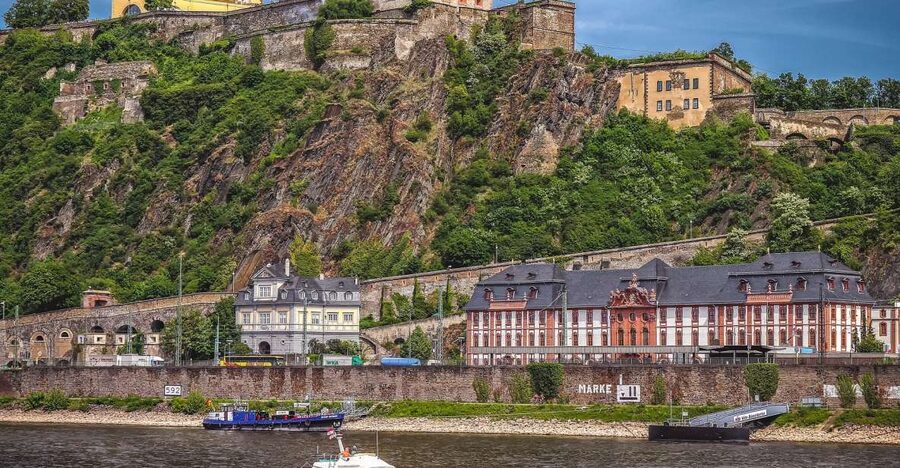
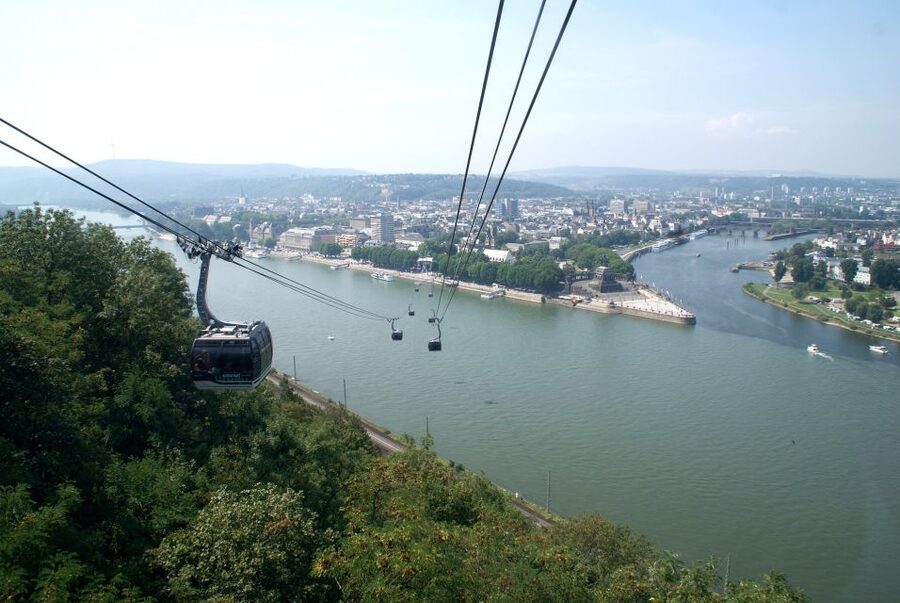
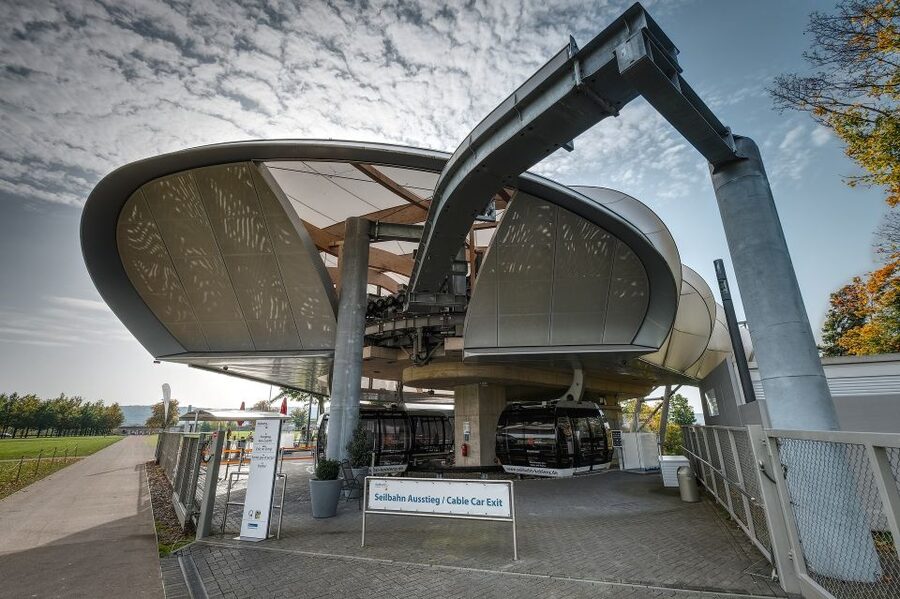
The tour begins at the cable car station on the Koblenz side. From here, you head up to Ehrenbreitstein Fortress, which sits 118 meters above the Rhine. Starting high is a smart choice: you get the broadest view first, then spend the rest of the tour among the streets and squares below.
The fortress you see today was built between 1817 and 1828 as part of a plan to protect the Middle Rhine region. Its position made it a natural defensive site. From the heights, you can look across the Rhine Valley and understand why armies cared so much about this ridge.
This is not just an old stone castle with a scenic overlook. It is a large military complex with a long and difficult past. French troops destroyed the earlier fortification in 1801. The later Prussian fortress was rebuilt in the early nineteenth century, creating the massive structure visited today.
The site also has a literary connection. British poet Lord Byron wrote about Ehrenbreitstein after its destruction, describing its battered walls and the contrast between warfare and peace. That detail gives the fortress a human edge. You are not simply looking at defensive walls. You are seeing a place that inspired reflection on what war leaves behind.
Your guide’s explanation matters here. The fortress is large, and three hours is not enough to examine every corner. A guide can point out why the site was built, explain the rebuilding, and keep your visit focused instead of letting the scale become confusing.
The cable car adds an easy practical benefit. The fortress is connected to Koblenz by cable car, so you do not need to treat the ascent as a strenuous hike. The tour is listed as wheelchair accessible, though the exact route through historic spaces can still matter for anyone using a mobility device. If that is important for you, confirm the day’s access details before booking.
Admission to Ehrenbreitstein Fortress is not included in the tour price. Set aside extra money for that ticket. The separate entrance cost is the main additional expense to remember when comparing this tour with a simple walking tour of the city.
More Fortress and Citadel Tours in Germany
- Erfurt: Guided Tour of The Petersberg Citadel
★ 4.8 · 674 reviews - Dresden: Königstein Fortress Paddle Steamer Cruise
★ 4.6 · 591 reviews - Erfurt: Flashlight tour of the petersberg citadel
★ 4.8 · 74 reviews
Münzplatz and Koblenz’s Roman Beginning
After the fortress, the tour moves into Koblenz’s Old Town and reaches Münzplatz. The square’s name comes from the electoral coin called the Münz, minted here in the eleventh century. That small fact helps explain how power worked in medieval Koblenz, when religious rulers also controlled money and territory.
Münzplatz also connects the modern city to its Roman origin. The Romans founded a fort here called Castellum apud confluentes, meaning the fort at the confluence. Koblenz owes its name to this location, where the Rhine and Moselle meet.
The square has a more recent marker too. A fountain created by Wili Heinzen was given to the city and its people by Sparkasse Koblenz for the 2,000-year anniversary in 1992. It is the sort of detail that can slip past you on an ordinary walk. With a private guide, you can ask questions and spend a little longer on the parts that interest you.
Münzplatz works well as an early Old Town stop because it gives you a clear sense of time. Roman military settlement, medieval coin production, and modern civic pride all appear in one place. You get context before moving on to the churches and public squares.
The Street Between Liebfrauenkirche and St. Castor
From Münzplatz, the route follows a romantic street between two important churches. This section gives the tour a slower, more architectural rhythm after the wide views at the fortress.
Liebfrauenkirche rises at the highest point of the city. Its onion domes make it easy to recognize, even among the Old Town’s dense buildings. The church was built in the seventeenth century, destroyed in 1944, and rebuilt in 1955. That sequence is worth noting because much of what you see in Koblenz reflects both older traditions and twentieth-century reconstruction.
During the French Revolution, Liebfrauenkirche was one of the city’s main parish churches. Its role was not limited to appearance. It served the religious life of the town while Koblenz passed through periods of political change.
The Basilica of St. Castor is older. The Archbishop of Trier founded it between 817 and 836 with support from Emperor Louis the Pious. It was built as a Carolingian proprietary church and is considered the oldest church in Koblenz.
Seeing the two churches together makes the route more useful than a list of separate monuments. Liebfrauenkirche shows a seventeenth-century foundation and postwar rebuilding. St. Castor reaches back to the Carolingian period. You can compare their age, style, and place in the city rather than treating each one as an isolated stop.
The tour information does not promise extended interior visits at every church, so your guide may focus on the exterior and the surrounding street depending on timing. That is one reason the private format helps. If church architecture matters to you, say so at the start and ask how much time can be given to each site.
The Schängel Fountain and Koblenz’s Local Character
The next part of the walk moves toward picturesque squares and the city hall area. Here you encounter the Schängel Fountain, one of Koblenz’s best-known symbols.
The name Schängel comes from Koblenz’s 20-year allegiance to France, from 1794 to 1813. Carl Burger designed the fountain in 1940, and it was dedicated to poet Josef Cornelius. That local connection makes the fountain more than a decorative stop.
I like this part of the route because it shows how a city expresses its identity through a nickname, a poet, and a public fountain. You do not need a long lecture to appreciate it, but a few clear facts turn a quick photo stop into something memorable.
A private guide can also add the sort of smaller attraction that is easy to miss when you follow only a standard sightseeing route. One guide on this experience has been praised for including both major historical sites and quirky attractions, with extra explanation at the fortress. That is the strongest reason to choose this format instead of simply walking from one famous building to the next.
More Medieval Old Town Tours in Germany
- From Frankfurt: Heidelberg, Castle and Old City Guided Tour
★ 4.5 · 677 reviews - Heidelberg Castle and Old Town Tour from Frankfurt
★ 4.0 · 587 reviews - Nuremberg: Castle and Old Town Tour – incl. Tickets and red beer tasting
★ 4.9 · 68 reviews - Nuremberg:Complete Tour! Castle/Old Town/World War history
★ 5.0 · 45 reviews
Deutsches Eck and the Kaiser Wilhelm Memorial
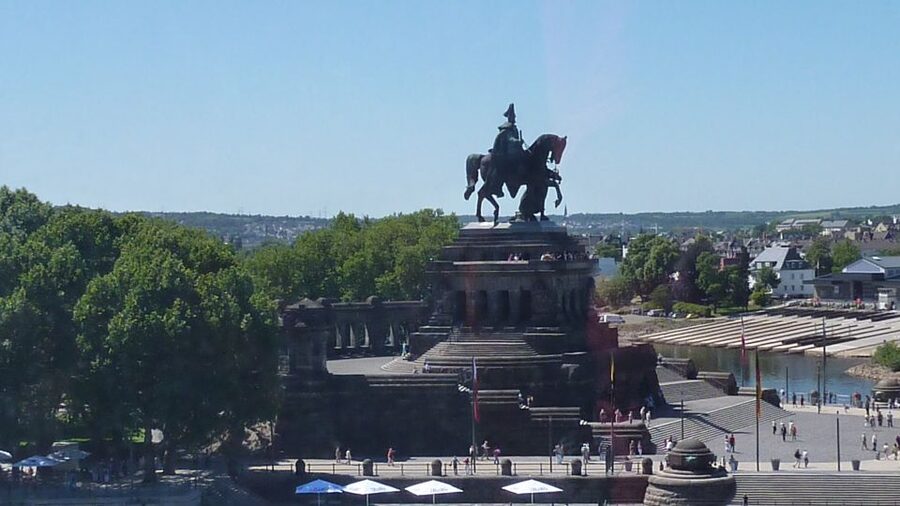
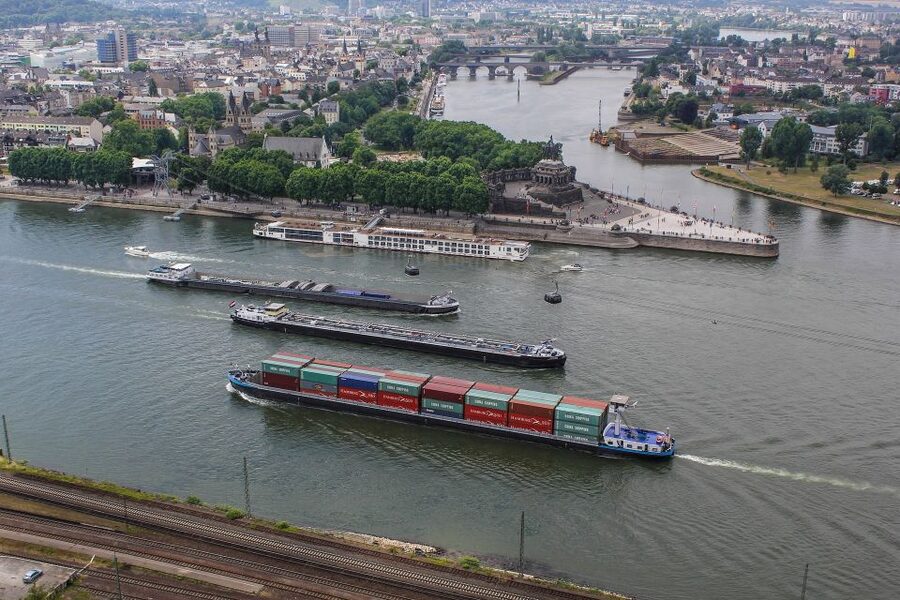
The final major stop is Deutsches Eck, the headland where the Moselle meets the Rhine. The name means German Corner, and the point is one of Koblenz’s most recognizable locations.
The Kaiser Wilhelm memorial was erected in 1897 for Kaiser Wilhelm I, the first German Emperor. Its position at the confluence gives the monument a powerful setting, but it also carries political weight. A guide can help you understand why this site became a national memorial and how it fits into the city’s story.
This is a fitting end because the tour returns to the water and the broad geography that shaped Koblenz from the start. At Ehrenbreitstein, you look down over the rivers from a defensive height. At Deutsches Eck, you stand at their meeting point. The two views complement each other.
The tour ends back at the meeting point near the cable car station. That makes the route relatively easy to understand, but it also means you should not expect a hotel drop-off at the end unless you arrange something separately. Pickup can be provided at a cruise docking location or at a centrally located hotel, which is useful if you are arriving in Koblenz for a short stop.
What Three Hours Really Gives You
Three hours is enough for a focused introduction, not a full study of Koblenz. You should expect a brisk tour with several landmark stops, explanations from a guide, and time for views and photographs.
The fortress takes up the most distinctive part of the experience. Its size, position, and military story give the tour a strong opening. The Old Town then supplies the details: Roman origins, coin minting, churches, a local fountain, and the city’s major memorial.
The private setup gives you more control than a large group tour. You can ask for clarification, request a little more time at a favorite stop, and avoid waiting for a crowd to gather. It also makes the $430 price easier to judge. For a group of 10, the cost works out to $43 per person before fortress admission. For 20 people, it is $21.50 each. For a couple, it is $215 per person, which is hard to justify unless you place a high value on a private guide.
The rating of 4.8 from four published ratings suggests strong satisfaction, but the sample is small. I would treat that score as encouraging rather than conclusive. The specific praise is consistent: the guide provides clear explanations, visits historically important places, adds unusual stops, and gives the fortress extra attention.
Languages, Access, and Who Will Enjoy It Most
The tour is offered in English, German, and Italian. That choice is useful for mixed-language families or groups who want explanations in their preferred language.
The activity is listed as wheelchair accessible. Since the route includes a historic fortress and Old Town streets, ask ahead about the exact path if you need step-free access at every point. The cable car connection reduces the need for a long climb, which is a practical advantage.
I would recommend this tour most strongly to:
- Cruise passengers who want a guided introduction during a limited stay
- Families or friend groups who can share the private group price
- First-time visitors who want both the fortress and Old Town in one outing
- History fans interested in Roman, Carolingian, French, and Prussian chapters
- People who prefer a guide who can explain small local details, not just point at monuments
It may be less suitable if you want a relaxed café walk, extended church interiors, or a full day at the fortress. It is also less attractive for one or two people on a tight budget.
Is the $430 Price Worth It?
The price is best understood as a group fee, not an individual ticket. Up to 20 people can join the private tour, and the guide is exclusively with your party. That can be good value for a family reunion, a small cruise group, or a group of friends who want a shared outing.
The value comes from the combination of places. A basic Old Town walk would not give you the fortress views, and a fortress visit alone would not cover Münzplatz, the churches, Schängel Fountain, and Deutsches Eck. You are paying for the route, the guide’s explanations, and the convenience of connecting these pieces in three hours.
Still, the fortress entrance is extra. Add that cost before comparing the total with other options. If your group is small, a public walking tour or separate sightseeing tickets may cost less. If you have a larger party, the shared price becomes much more reasonable.
Free cancellation up to 24 hours before the start gives you some protection if plans change. You can also reserve and pay later, which helps if your cruise or hotel schedule is not fully settled.
Should You Book This Koblenz Tour?
Book it if you want the main story of Koblenz in one compact outing, especially if you are sharing the cost with a larger private group. The strongest features are the Rhine Valley views from Ehrenbreitstein Fortress, the efficient Old Town route, and the guide’s ability to add both major history and less obvious local details.
Before booking, confirm the fortress admission cost and make sure the three-hour pace suits you. Ask for a guide in your preferred language, and mention if you want extra time for churches, architecture, or photography.
For a couple seeking the cheapest way to sightsee, I would hesitate. For a family, cruise group, or history-minded party that values personal guidance, this is a practical way to see Koblenz’s essential sights without wasting time finding your way between them.
FAQ
Where does the tour begin?
The tour begins at the cable car station on the Koblenz side.
Where does the tour end?
The activity ends back at the meeting point near the cable car station.
How long is the tour?
The tour lasts three hours.
What languages are available?
The live guide can conduct the tour in English, German, or Italian.
Is this a private tour?
Yes. The tour is for a private group of up to 20 people.
Is pickup available?
Pickup is available at your cruise docking location or at a centrally located hotel.
Is Ehrenbreitstein Fortress included?
The fortress is part of the tour route, but the entrance fee is not included in the tour price.
Is the tour wheelchair accessible?
The activity is listed as wheelchair accessible.
Can I cancel for a full refund?
Yes. You can cancel up to 24 hours in advance for a full refund.
Just added around Germany
- Sightseeing flight Zugspitze Neuschwanstein Castle Alps Munich Augsburg★ 5.0 · 7 reviews
- Stuttgart: Landesmuseum Württemberg Old Castle Entry Ticket★ 4.6 · 21 reviews
- Stuttgart: 4-Castle Winter Hike with Costume Tour★ 4.5 · 2 reviews
- Stein: Guided tour of Count von Faber-Castell’s castle★ 4.9 · 27 reviews
- Sigmaringen: Hohenzollern Castle Admission & Audio Guide★ 4.9 · 15 reviews
- Segway Tour: Gerberbach, Schlosspark & Castle Weinheim★ 4.9 · 14 reviews
- Dresden: Scavenger Hunt to Elbe River & Castles★ 4.7 · 15 reviews
- Private tour to Neuschwanstein castle from Munich★ 5.0 · 23 reviews
Fortress & Citadel Tours, compared.

Carcassonne: Castle and Ramparts Entry Ticket
Read our review →
From Cairo Alexandria Catacombs, Citadel Day Trip with Lunch
Read our review →
Charleston historical walking tour with a Professor of History at The Citadel
Read our review →
Hue Customizable Tour with Imperial Citadel & Forbidden City
Read our review →
Desert Safari: Luxury Fortress Dinner, Camel Ride & Dune Bashing
Read our review →
Egyptian Museum, Citadel, and Old Cairo Guided Tour
Read our review →Browse the lists this tour appears in