

Review · GERMANY
Berlin: Decolonial Berlin Castle/ Humboldt Forum Guided Tour
Berlin’s castle has a story beneath the stone. This two-hour guided experience brings an Afrocentric perspective to the Humboldt Forum, linking its reconstructed palace, ethnological collection, missionaries, and colonial power. I like the way it asks you to read the building and objects critically, and I like that the tour gives real attention to the Humboldt brothers and their place in German history. The main consideration is that about an hour takes place outside, so Berlin weather matters.
You meet near the reconstructed Sanchi Gate, where white chairs provide a place to sit before entering the museum. I appreciate that the tour is in English, includes entry to the ethnological collection, and is wheelchair accessible. At $41 per person, it is fair value if you want discussion and historical interpretation, but less so if you mainly want a quick look at the Humboldt Forum galleries.
Key points to know before booking

- About one hour begins outdoors: You sit near the reconstructed Sanchi Gate before heading inside, so wear weather-appropriate clothing.
- The focus is decolonial and Afrocentric: This is not a standard palace tour. It examines how colonial systems shaped Berlin, the museum, and its collections.
- The roof cross has a story: The guide explains the symbolic meaning of the cross and its connection to the building’s history.
- The ethnological collection is read critically: An audio walk helps you consider how objects were collected, labeled, and displayed.
- The Humboldt brothers receive special attention: You learn why Alexander and Wilhelm Humboldt remain important figures in German science and public memory.
- The experience is strongest as a discussion: If you want extended time inside the museum, know that some of the historical explanation happens before the gallery visit.
Why the Berlin palace needs more than a postcard view

The Humboldt Forum occupies the site and reconstructed form of Berlin’s former palace. That setting can look grand and finished at first glance, but this tour encourages you to pause over what the building represents.
You learn about roughly 500 years of palace history, not as a simple march from royal residence to modern museum, but as a story tied to power, religion, scholarship, empire, and cultural ownership. That wider frame is the reason I find this experience more useful than a conventional architectural walk.
The tour also asks you to consider how a building can carry several messages at once. The palace reconstruction refers to older German history, while the museum inside holds collections from outside Europe. The result is not neutral. You are encouraged to think about who built the institutions, who collected the objects, and whose voice shaped the official story.
That approach may feel challenging if you expect a traditional account of Berlin’s rulers and monuments. It is meant to challenge that approach. The guide gives you a different set of questions, and those questions continue to matter once you enter the museum.
More Guided Castle Tours in Germany
- From Frankfurt: Heidelberg, Castle and Old City Guided Tour
★ 4.5 · 677 reviews - Erfurt: Guided Tour of The Petersberg Citadel
★ 4.8 · 674 reviews - Neuschwanstein Castle Ticket With Audio Guided Tour
★ 3.5 · 473 reviews
Starting beside the reconstructed Sanchi Gate
The meeting point is near the reconstructed Sanchi Gate. Look for the white chairs, where the group sits outdoors for approximately one hour before going inside.
This opening section is a major part of the experience, not dead time before the museum begins. The guide uses the palace and its surroundings to establish the historical background, including colonialism and the role of German institutions in creating and preserving colonial structures.
Because you are seated, the first hour may be comfortable for many people, though it can feel long if you came expecting to start inside the galleries. Bring a coat, rain protection, or sun protection according to the forecast. Comfortable shoes still make sense because the full visit combines an outdoor meeting point with museum time.
The location also makes the opening easy to identify. You do not need to search through a large museum lobby for a guide. Still, pay close attention to the meeting instructions, since one booking problem reported for this experience involved a participant waiting at the wrong event after misunderstanding the actual provider. Check the tour name and meeting point carefully before you arrive.
Colonialism and the making of museum power
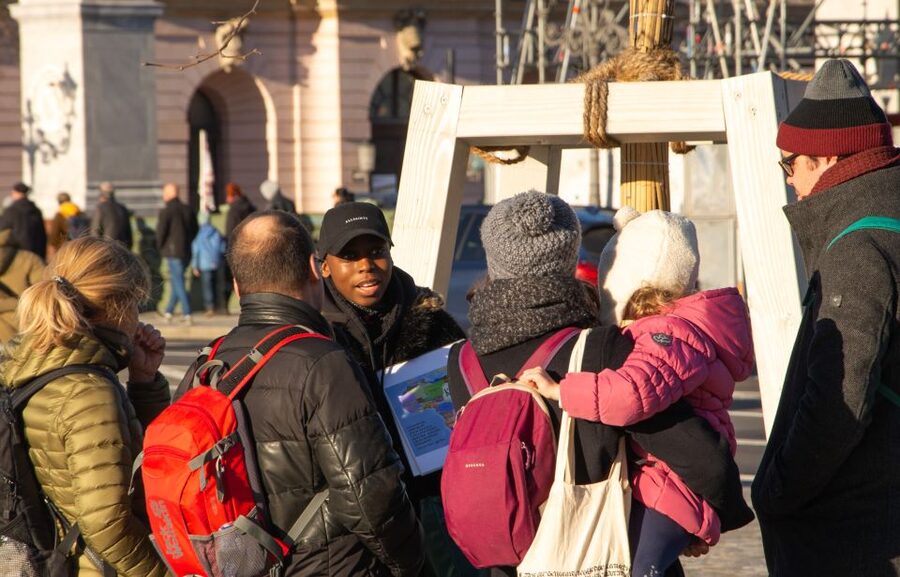
The strongest part of this tour is its treatment of colonialism as a structure, not just a chapter in a textbook.
You learn how colonial systems affected the gathering of knowledge, the movement of objects, and the stories later told in European museums. The discussion includes missionaries and the part they played in establishing colonial structures. That detail is important because it moves the subject beyond kings, armies, and formal government. Religious workers, scholars, collectors, and institutions could all help create the conditions in which colonial power grew.
I value this kind of explanation because it helps you read the museum itself. An object on display is not only an artwork or artifact. It may also carry a story about who removed it, who described it, who placed it in storage, and who later decided how the public should see it.
The tour does not appear designed to make the subject comfortable. Its purpose is to create new narratives and to bring Afrocentric insights into a place traditionally read through European institutions. If you prefer a tour that stays strictly descriptive, this may feel too argumentative. If you want to examine the assumptions behind museum displays, it gives you useful material to think about.
The Humboldt brothers and German science
Alexander and Wilhelm Humboldt are another important thread. The tour explains why the brothers matter in German history as scientists and public figures.
Their names are attached to the forum, so learning about them gives the museum a human and intellectual context. You are not simply told that the building carries the Humboldt name. You are shown why these figures were important and how their legacy fits into German ideas about science, education, collecting, and knowledge.
The supplied information does not promise a biography of every stage of their lives, so you should not expect a full family history. Instead, their role supports the larger argument of the tour: knowledge is never entirely separate from the systems that fund it, organize it, and give it public authority.
That is a useful distinction. A standard museum visit might leave you admiring the name without asking why it was chosen. Here, the Humboldt brothers become part of the discussion about how Germany understands science, culture, and its own past.
Same region, a different set of walls:
- From Munich: Neuschwanstein & Linderhof Castle Full-Day Trip
★ 4.6 · 14,646 reviews - Neuschwanstein & Linderhof Castle-Fairytale Day Tour from Munich
★ 4.5 · 7,275 reviews - Neuschwanstein Castle Tour from Munich
★ 4.5 · 5,117 reviews - From Munich: Neuschwanstein Castle Full-Day Trip
★ 4.7 · 3,977 reviews
The cross on the roof and the meaning of reconstruction
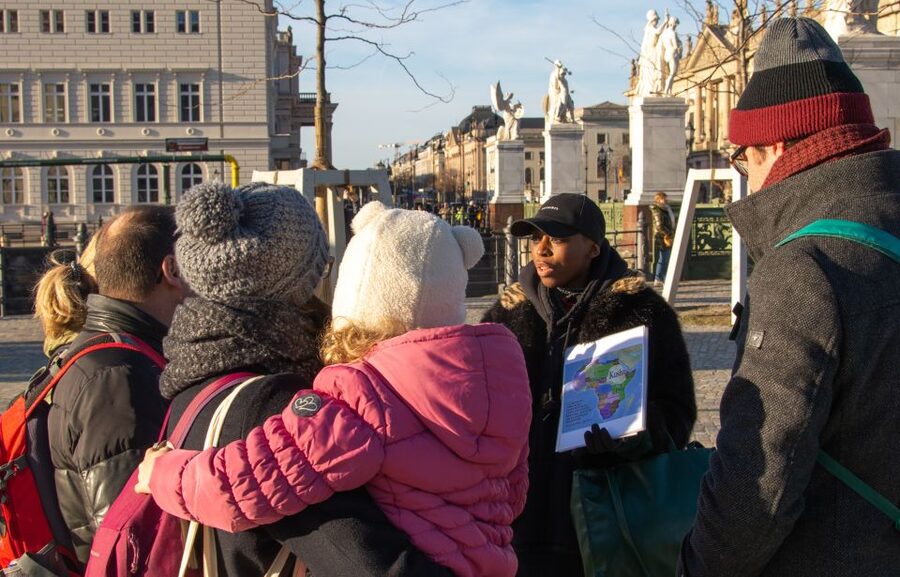
One of the most striking details is the explanation of the cross on the museum roof.
The cross is not treated as a decorative finishing touch. You learn about its symbolic meaning and how it relates to the history of the palace and the building’s present identity. That matters because the reconstructed exterior makes historical choices visible. The roofline, facade, and symbols tell visitors what kind of past deserves to be recalled.
A reconstruction can suggest continuity, but it can also leave difficult questions in the shadows. Which past is being restored? Which parts are left out? What does a Christian symbol communicate above a museum that displays collections from societies shaped by European colonial activity?
The tour does not ask you to look at the cross in isolation. It connects the symbol to the palace, missionary work, colonial structures, and modern cultural memory. Even if you do not agree with every interpretation, you will leave with a more alert eye for the messages built into historic architecture.
Inside the ethnological collection
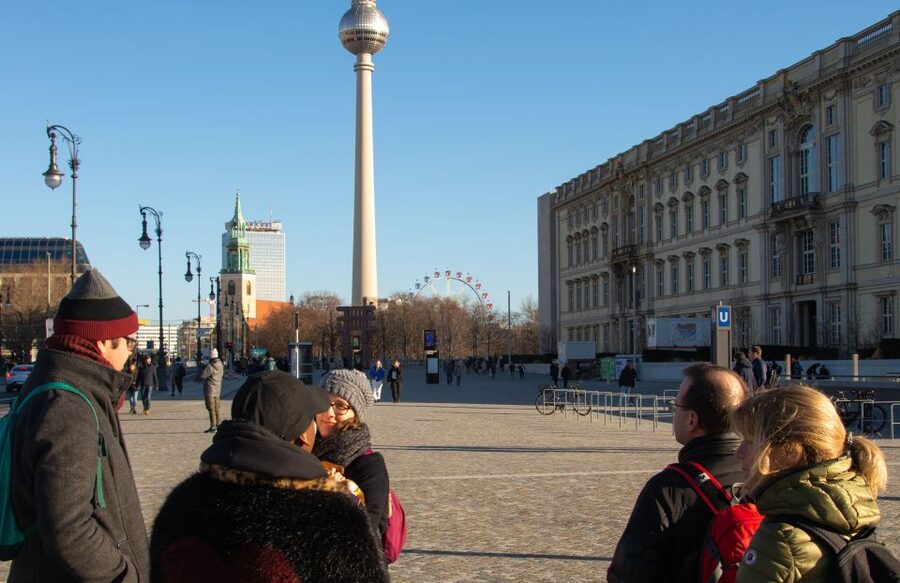
After the outdoor discussion, you enter the Humboldt Forum and visit the ethnological collection. Entry to this collection is included in the price.
The indoor section uses a critical approach rather than a simple march from case to case. You receive an audio walk that helps you examine the collection and consider how the objects have been interpreted. This is useful if you have ever looked at a museum label and wondered who chose the words.
The information provided does not identify a fixed route through every gallery, so the exact objects and displays you discuss may depend on the guide and the current presentation. The practical point is that the museum portion is not the entire two hours. One assessment of the experience found that the historical background left less time for the forum itself. You should book this with the right expectation: the Humboldt Forum is the setting for a critical history tour, not the sole subject of a long gallery visit.
I like that balance. The audio walk gives you a tool to continue looking after the guided portion ends, while the guide supplies the context that an audio device alone cannot easily provide. Still, if your goal is to see as many displays as possible, you may wish to return independently at another time.
What the two-hour format feels like
Two hours is enough to introduce the palace, the Humboldt brothers, colonial structures, missionary activity, the roof cross, and the ethnological collection without turning the experience into an all-day commitment.
The tradeoff is pace. The outdoor conversation takes approximately one hour, leaving the rest for entering the museum and examining the collection. That structure favors ideas over quantity. You spend less time racing through rooms and more time listening, asking questions, and connecting the building to its past.
This also explains why the tour can feel different from a typical sightseeing activity. The guide is not simply pointing out a facade and naming dates. The experience asks you to think about language, authority, and cultural heritage in the modern day.
Past guide feedback has been especially strong on competence, information, and keeping the subject engaging. That matches the design of the tour: the topic is serious, but the discussion is intended to avoid a dull lecture. At the same time, the experience depends heavily on the guide’s delivery. A poor meeting experience was reported on one occasion, so I would arrive early and confirm the exact location.
Is $41 a fair price?

At $41 per person, the price is reasonable for a two-hour guided museum experience if interpretation is your priority. You receive a live English-speaking guide and entry to the ethnological collection, rather than paying only for access to the building.
The value comes from the point of view and the connections between subjects. You are paying for a guided reading of the palace, the museum, the collection, and colonial history. Those links would be easy to miss on a normal visit.
The value is weaker if you want a broad tour of every Humboldt Forum exhibition. The experience spends substantial time outside and places the main emphasis on decolonial history. You may feel that the gallery visit is brief, especially if you expected a full museum orientation.
I would compare it to a focused seminar with a site visit, not to a conventional museum highlights tour. For the right audience, that makes $41 a sensible cost. You also have the option to reserve now and pay later, with free cancellation up to 24 hours before the start time, which helps if your Berlin plans are still shifting.
Who will get the most from this experience?
I would recommend the tour to you if you want to examine Berlin’s colonial legacy, museum collecting, and public memory from a perspective that is not centered only on European voices.
It suits:
- First-time visitors who want historical context before exploring the Humboldt Forum alone
- Repeat visitors who have already seen Berlin’s major monuments and want a more critical reading
- Students, teachers, and museum enthusiasts interested in colonial history
- People curious about Afrocentric approaches to German cultural institutions
- Visitors willing to spend a significant part of the tour seated outdoors
It may not suit you if you want a fast architectural tour, a purely neutral tone, or a long gallery visit. The approach is openly interpretive. One participant strongly disliked the way the tour assigned new meaning to historical material, while other feedback praised the topic and the guide’s ability to make it informative. That contrast tells you something useful: your expectations and comfort with critical historical discussion will shape the experience.
Practical advice for a smoother visit
Wear comfortable shoes and dress for the weather. Even though you sit for much of the opening hour, you will be outside before entering the museum.
Do not bring food, drinks, luggage, or large bags, since these are not allowed. The tour is wheelchair accessible, which is helpful for visitors who need step-free access, though the outdoor seating setup is worth keeping in mind when planning your arrival.
The guide is in English. Meet near the reconstructed Sanchi Gate and look for the white chairs. I would arrive with enough time to identify the group, especially because the opening takes place outside rather than at an obvious indoor ticket desk.
The activity has two possible starting location entries associated with the Sanchi Gate area. Confirm the exact point on your booking details rather than relying on a general map pin.
Should you book the decolonial Humboldt Forum tour?
Book it if you want the Humboldt Forum to raise questions, not just provide photographs. The tour’s best features are its Afrocentric perspective, its explanation of colonial structures and missionary activity, and its close attention to the meaning of the palace, the roof cross, and the ethnological collection.
Skip it if you mainly want to see many galleries or hear a traditional account of Berlin’s royal past. You will spend about half the tour outdoors, and the museum portion may feel short.
For me, the deciding question is simple: do you want a comfortable list of facts, or do you want to examine how those facts were selected and presented? If you choose the second, this focused two-hour experience offers a useful and thought-provoking way into the Humboldt Forum.
FAQ
Where does the tour meet?
Meet your guide near the reconstructed Sanchi Gate. White chairs mark the outdoor meeting area.
How long does the tour last?
The experience lasts two hours. Approximately one hour is spent seated outside before the group enters the museum.
Is the tour conducted in English?
Yes. The live tour guide speaks English.
Is entry to the ethnological collection included?
Yes. Entry to the ethnological collection is included, along with the guided tour.
Is the tour wheelchair accessible?
Yes, the activity is listed as wheelchair accessible.
What should I bring?
Bring comfortable shoes and weather-appropriate clothing. Food, drinks, luggage, and large bags are not allowed.
Just added around Germany
- Sightseeing flight Zugspitze Neuschwanstein Castle Alps Munich Augsburg★ 5.0 · 7 reviews
- Stuttgart: Landesmuseum Württemberg Old Castle Entry Ticket★ 4.6 · 21 reviews
- Stuttgart: 4-Castle Winter Hike with Costume Tour★ 4.5 · 2 reviews
- Stein: Guided tour of Count von Faber-Castell’s castle★ 4.9 · 27 reviews
- Sigmaringen: Hohenzollern Castle Admission & Audio Guide★ 4.9 · 15 reviews
- Segway Tour: Gerberbach, Schlosspark & Castle Weinheim★ 4.9 · 14 reviews
- Dresden: Scavenger Hunt to Elbe River & Castles★ 4.7 · 15 reviews
- Private tour to Neuschwanstein castle from Munich★ 5.0 · 23 reviews
Guided Castle Tours, compared.

Edinburgh Castle: Guided Walking Tour with Entry Ticket
Read our review →
Cathedral, Giralda & Alcazar Entry With Guided Tour
Read our review →Edinburgh Castle: Guided Walking Tour with Entry Ticket
Read our review →
Stonehenge, Windsor Castle and Bath Full Day Guided Tour
Read our review →
Edinburgh Castle Guided Walking Tour in English
Read our review →
Alcázar and Cathedral Entry Ticket and Guided Tour
Read our review →
Alcázar of Seville Skip-the-Line Tickets and Guided Tour
Read our review →
Dublin Book of Kells, Castle and Molly Malone Statue Guided Tour
Read our review →Browse the lists this tour appears in